Categories
AI State of the Web The Essentials Web Design History Web Standards

Receipts: a brief history of the death of the web.

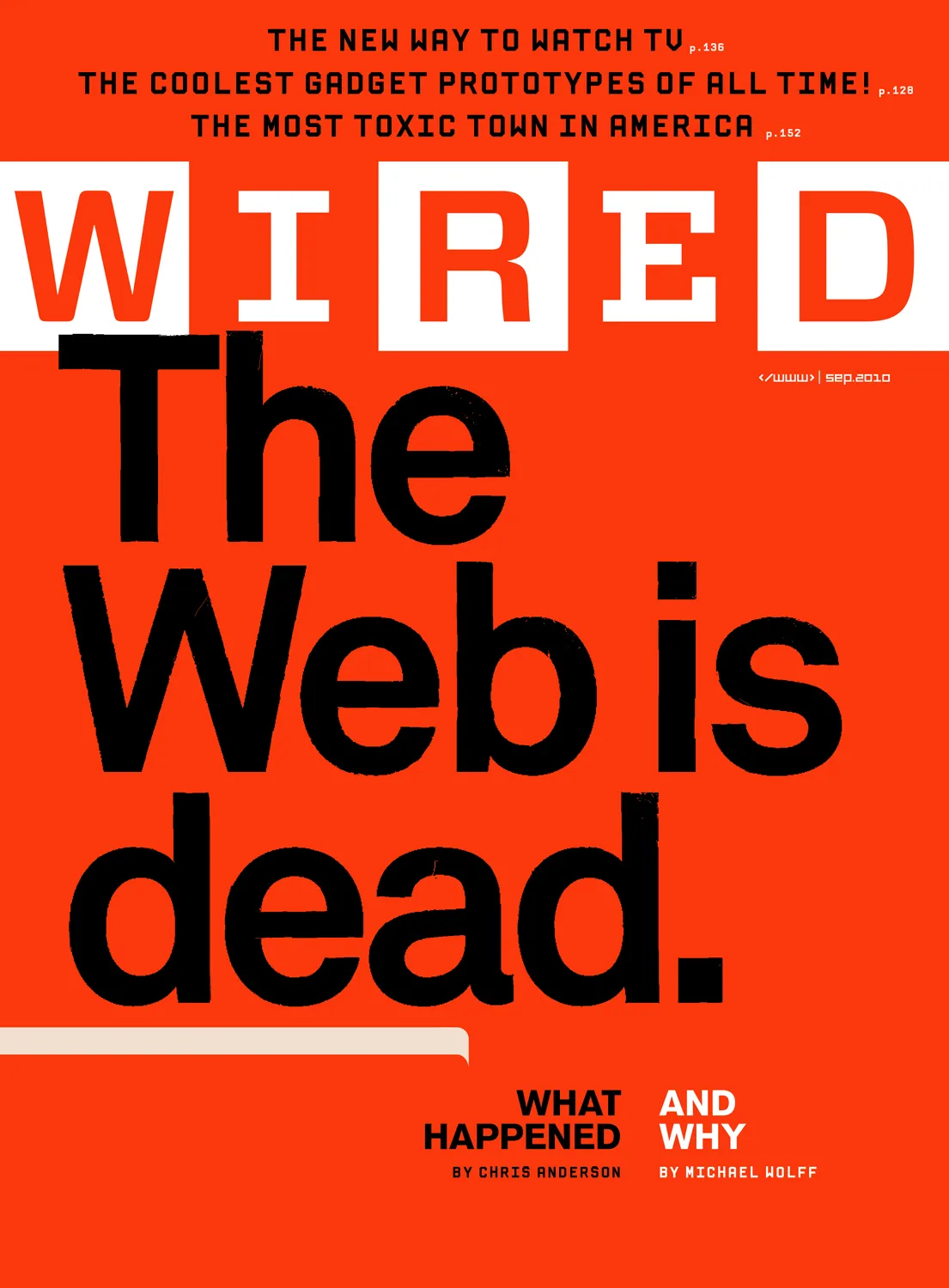
They say AI will replace the web as we know it, and this time they mean it. Here follows a short list of previous times they also meant it, starting way back in 1997.

Wired: March 1, 1997: “You can kiss your web browser goodbye” – Kevin Kelly and Gary Wolf, The Big Story.

Inspired by the success of PointCast, a clever application that displayed news headlines as a screensaver, our “Push!” story argued that Web browsers were about to become obsolete. 

(I repeat, this was 1997. The Wayback machine was roughly one year old. Primitive CSS was newly available in IE3, but most folks at the time continued to use the Netscape browser, which they bought on disc at their neighborhood computing store.)

Wired: May 1, 2004: “The Return of Push!” – Gary Wolf

Though I dubbed it “the worst story Wired ever published,” I quickly began to get feedback from readers who argued that the predictions in the piece were coming true after all. The inspiring technology this time is RSS, a specification that allows easy syndication of news, blogs, and other frequently updated sources.

There is a clear parallel between the excitement of the PointCast days and the enthusiasm for RSS today, one that goes further than easy harvesting of news headlines. Search engine results, product information, new music, notification of recent blog comments, and many other types of digital information are becoming available through RSS. This dialect of XML brings us the Web as an evolving environment: customizable, variable in intensity, and always on. This is the old promise of push. We can see the potential for radically new types of media – again.

To be fair, whereas the 1997 story made mountains out of an early “push” app, this 2004 second attempt to declare the web dead caught a moment of genuine game change as RSS, Atom, and XML provided dependable web standards (not a lone application, as in the 1997 piece) for syndication.

But syndication, of course, did not kill the web; it brought forward much of its inherent value. All praise to Dave Winer and his confederates for RSS and Atom, and to WaSP member Tim Bray and his colleagues for XML: here’s a contemporary history of how that standard came to be.

You’d think Wired would be tired (see what I did there?) of hyping the end of the platform that gave the magazine its relevance, but no:

Wired: August 17, 2018: “The Web Is Dead. Long Live the Internet.” – Chris Anderson and Michael Wolff, The Big Story.

Two decades after its inception, the World Wide Web has been eclipsed by Skype, Netflix, peer-to-peer, and a quarter-million other apps.

(Observation: A Wolf wrote or co-wrote the first two articles, and a Woolf co-wrote the third. A meaningless coincidence, but if this were politics instead of tech, there would doubtless be a whole QAnon-style conspiracy theory about it. Especially since Woolf is often a Jewish surname. But I digress.)

The web profoundly changed the world, for better and worse, with the jury still out on some charges, but one thing hasn’t changed: every few years someone in an intellectual leadership position declares the web kaput. It survived previous bubbles (starting with the dot-com crash) and has proved hardy enough to continue providing profound benefits and hazards to the entire world, absorbing and deepening new technologies rather than succumbing to them.

Look, I understand why AI is bigger than Pointcast and how it is disrupting anything it can be stuck in, but the web is not going away. ’Cause think about it for five minutes, which is four and a half minutes longer than the authors of the previous hype cycles appear to have done. If AI kills the web that provides the information AI sucks down, then there is no contemporary body of news and text for AI to suck down and regurgitate. It would be like a parasite that kills the host body. There are occasionally such things in nature, but mostly, life finds a way, mostly. And so will the web. Now a word about those self-driving cars….

Categories
AI glamorous

My Glamorous Life: Bots, Books, and Betrayal

My father was an engineer who designed robots. When I first learned what he did, I imagined the Robot from “Lost in Space,” and asked him to make me one. When I turned 13, I realized that the pick-and-place robots he designed replaced assembly-line workers, and asked how he, who’d been a socialist in his impoverished youth, could create something that took anyone’s job away.

“Those are depressing, repetitive jobs,” he said. “Those folks can be trained to do more interesting work: work that stimulates their mind. Pays lots better, too.”

Actually, that’s what he meant to say, but how he expressed it was:

“A steam shovel takes away the job of 1000 Coolies digging with teaspoons. Should we not have steam shovels?”

Oof. My father and his words.

Uh-oh. Let me explain…

My father didn’t mean to be racist with that “Coolie” crack. He was as anti-racist as any white man of his generation, which in his case was actually a lot.

Like he wouldn’t watch “Gone With the Wind” because, in his words, “it’s anti-Negro.”

He would say this angrily, with wet eyes.

As a young man, my father had been a civil rights worker who worked to enroll voters in Harlem. His heart was in the right place.

(But also: He had major emotional problems, constant bubbling rage from untreated childhood trauma, and undiagnosed autism, which made him brilliantly inventive and creative, but which—combined with the broken self-esteem and bottomless pit of rage—left him incapable of speaking for ten minutes without offending someone, often profoundly. Where was I? Oh, yes.)

Maurice Zeldman as a young man. He is seated at a couch, a lamp beside him, in what appears to be a comfortable living room. The photographer appears to have surprised him while he was reading. His expression is fathomless.
Maurice Zeldman as a young man.

As for the “Negro” in “anti-Negro,” my father was taking his lead from the Black community itself. This was the era of the United Negro College Fund and the NAACP, when a white person calling a Black person a “Negro” was showing respect, strange as it sounds to modern ears.

And he was profoundly right about that damned film, which whitewashed slavery and depicted Black people as either sweet, overgrown children or violent rapists crazed by white flesh. Still later in my life, when cable TV became a thing, it appalled me that Ted Turner played “Gone With the Wind” seemingly every other week on his big channels, TNT and TBS. I’m not saying it’s a badly made or unambitious film. Just that it’s racist af. So fuck Ted Turner. Fuck him for platforming “Gone With the Wind” every ten minutes. Fuck him two times for creating the 24-hour cable news cycle. Look where that’s gotten us.

But I digress.

Clark Gable, who tragically lost his teeth at age 32.

(NOTE: I can’t watch any film with Clark Gable since I learned that he wore dentures that stank—something his glamorous leading ladies had to endure during dialog and kissing scenes. It’s not that I judge the poor man for his health problems and the state of dentistry in the 1930s. It’s just that, ick, it shatters the romantic illusion movies work so hard to create. But I digress again. I can’t watch “Gone With the Wind” because it is racist, and I’m glad my father gave me that understanding when I was young.)

Beep Boop

Book cover: "What Every Engineer Should Know About Robots" by Maurice I. Zeldman

Wait a minute, how did I get into all this? I was talking about my dad creating robots for Perkin-Elmer, American Machine & Foundry, and Rockwell International. Robots that didn’t look anything like the talking, beeping 1950s sci-fi robots in the old movies I grew up adoring. 

I was talking about how my once-socialist, pro-worker dad helped create products (like pick-and-place robots) that replaced human workers on the assembly line.

Not that that reminds me of anything happening today. Although I should probably ask my chatbot to check and make sure.

(That’s humor, kid—is what my dad would have said.)

Betrayed!

By the way, if you’re so inclined, you can buy a Kindle copy of my dad’s book, “What Every Engineer Should Know about Robots,” from you-know-who. Technically, my father and I wrote the book together: he supplied the knowledge, I brought the writing chops.

When he brought me in on his book-writing assignment, my father promised to share a coauthoring credit with me. But in the end, he couldn’t bring himself to do it. Instead, I was listed in an acknowledgement as a “creative editor,” whatever that means.

I found out when I saw the printed book that I’d been denied my credit.

My dad could have told me in advance. He could have lied and said the publisher insisted on only crediting one author. How would I have known any different? I was only 23.

But he said nothing.

Not that I’m bitter. My dad was profoundly abused in his childhood. While he came across as having a huge ego, inside he was more fragile than silence. To have given me the boost my writing career desperately needed at the time was simply too difficult for him. It needed to be his book, so everyone would know Murray Zeldman was a genius.

At least, that’s what my mother told me when she saw me sitting quietly in a corner, looking like I’d been gut punched.

I have long understood and forgiven my dad, although at the time I could only feel hurt. (Also at the time I was working blue- and grey-collar jobs that barely covered my rent and bus fare; even if it didn’t immediately boost my financial circumstances, it would have been swell for my self-esteem to have the publishing credit I’d earned. But I digress.)

Besides, it was a great learning experience: mindful of the pain I felt when cheated of my credit, I’ve made it a point during my decades of work to always credit my colleagues for their contributions. I hope I have not failed to do that.

But we were talking about chatbots or something. Right?

Say, look here, I’ll tell you what Claude.ai and ChatGPT can’t do: write a memoir as disorganized, digressive, and curdled in the stench of resentment as this here—but what is this thing I’ve written here, anyway? A lament? A word salad dressed in thousand island tears? Who can say? I was dreaming when I wrote this.

For you. Always for you, my dear daughter.

Categories
AI family glamorous project management software

My father, Maurice Zeldman, and his ZGANNT software

My father, Maurice Zeldman, was a giant in the field of project management, though I suspect few in my world of web standards and design would recognize his name. Dad consulted for over 180 organizations and led seminars around the world. Project managers everywhere used his techniques to create realistic estimates and timelines that actually worked—a rare skill in any technical field, then and now.

Before founding EMZEE Associates (the name a play on his initials, M.Z.), Dad was Corporate Director of Technical Development for Rockwell International’s Industrial & Marine Divisions. He designed, built, and staffed their entire Engineering Development Center. Earlier in his career, he worked with Perkin Elmer developing an Atomic Absorption Spectrometer and with American Machine & Foundry as Chief Engineer of their Versatran Robot division. His robotics knowledge led to his book Robotics: What Every Engineer Should Know, published by CRC Press in 1984, followed by Keeping Technical Projects on Target, an AMA management briefing.

EMZEE Associates, Dad’s consulting and training company, specialized in project management and technology implementation. While I was designing websites and campaigning for web standards in the mid-90s, Dad was already running a successful business teaching Fortune 500 companies how to bring their complex technical projects in on time and under budget.

Then there was ZGANTT, his DOS-based project management software from the late 80s/early 90s. The name combined “Zeldman” with “Gantt chart—those horizontal bar charts showing project schedules that are still used today. While I was learning to code and finding my path, Dad had already created specialized software implementing his project management methodologies. This was during the first wave of specialized project management tools, before Microsoft Project took over the market.

Looking back, I realize my obsession with systems, standards, and improving how people work together didn’t come from nowhere. While I applied these principles to web design, Dad had been applying similar thinking to the complex world of project management decades earlier. His ZGANTT software and EMZEE Associates consultancy were direct expressions of his belief that the right methods, correctly implemented, could bring order and success to even the most complex technical challenges.

Categories
AI Applications art art direction Design

This Years Model

There’s a new AI model that can render photorealistic people and products, including text and logos.

Geisha With Walkman is something I tried to draw 40 years ago, but my rendering skills were simply too poor. The Reve Image 1.0 preview allowed me to do it instantly this morning with a single, basic prompt.

P.S. I retro-updated the Walkman with an iPod to “modernize” the concept.

Categories
AI Law & Legal Off My Lawn! State of the Web

Your opt-innie wants to talk to your opt-outtie.

Here’s a fact: “Opt-in” is great for programs a platform controls, but meaningless when that platform has no control.

Take, for example, oh, I don’t know, let’s say AI companies scraping web content without your permission. The heart wants to make content scraping permissions “opt-in,” so people who post content online are protected by default.

Except we won’t be. Smaller, “good” AI companies may comply with “opt-out” notices; big ones surely won’t. Scrapers gonna scrape.

So why even bother with an “opt-out” setting? Because companies that continue to scrape opted-out content may find themselves on the losing end of major lawsuits.

Of course there’s no telling how these lawsuits will work out—not with ketamine supervillains and their GOP enablers willfully violating consumer, worker, and climate protection laws here in the benighted States of America. But even so, an opt-out notice is a red line, and most corporate legal teams are cautious and sober—at least during working hours.

An opt-out notice is *something.* It smells funky, but has a chance of working.

Of course opt-in feels better. It’s how we’d do things if we had control over third-party scrapers. But we don’t have that control.

Which makes opt-in for AI scraping a feel-good but basically performative gesture. And we don’t have time for those.

However pretty it might be to think otherwise, something imperfect that might work beats something pure that won’t. Don’t hate me ’cause I’m beautiful. I’m only here to tell you what we both know in our souls.

Your AI sponsor,

z

Photo by Tingey Injury Law Firm on Unsplash.

Categories
AI automattic Blogs and Blogging content guestbook spam Indieweb industry Own your content software State of the Web Surviving The Essentials Websites

Akismet means never having to say you’re sorry

The wizards behind AI have been busy lately providing meaningful employment for digital nonpersons.

One of the hottest jobs for non-humans is crafting and deploying website guestbook spam. This market’s on fire!

If you thought the guestbook spam of yore was impressive, you ain’t seen nothing yet. The new, AI-assisted comment spam has improved keyword stuffing, fewer grammatical mistakes, and, best of all, there’s tons more of it. Your Comment section was never so useless!

And we’re not just talking quantity, here; we’re talking quality.

Compared to the spammers of yore, the new signal depressors have a bold confidence that proclaims, “Hello, world! I’m here to waste your time and extinguish what’s left of your hard-won reader community. Watch me work!”

Yes, the bots who shit in your sandbox are bigger, brassier, and better than ever at wasting your readers’ time and abusing your content to score points on the Google big board.

What’s that you say? You’re not a comment spam enthusiast?

In that case, do as I do: use Akismet to keep cruft where it belongs: off your website. Akismet was strong enough for the comment, form, and text spam of the past, and it’s strong enough for the new junk, too.

(Full disclosure: I work at Automattic, makers of Akismet, but I penned this post this morning purely as an Akismet customer, after happily reviewing the blocked comment spam on this here WordPress site of mine. Thanks, Akismet!)

Categories
AI Best practices Education environment ethics planet

AI Roundup: The Bad, the Ugly, and the Pretty Cool

Ay, ay, AI! Hype, fear, and strongly voiced opinions—the traditional currency of internet conversation—are unequal to this moment, where the Fate of Everything™ dangles from a single gossamer thread. So here are four useful links to pieces of the web that make differing and complementary sense of the threat and promise of AI.

Of course AI is a bubble. It has all the hallmarks of a classic tech bubble. Pick up a rental car at SFO and drive in either direction on the 101—north to San Francisco, south to Palo Alto—and every single billboard is advertising some kind of AI company. Every business plan has the word “AI” in it, even if the business itself has no AI in it…

Tech bubbles come in two varieties: The ones that leave something behind, and the ones that leave nothing behind. Sometimes, it can be hard to guess what kind of bubble you’re living through until it pops and you find out the hard way…

Cory Doctorow: What Kind of Bubble is AI?

de Vries calculates that by 2027 the AI sector could consume between 85 to 134 terawatt hours each year. That’s about the same as the annual energy demand of de Vries’ home country, the Netherlands. 

The Verge: How much electricity does AI consume?

The Elements of AI is a series of free online courses created by MinnaLearn and the University of Helsinki. We want to encourage as broad a group of people as possible to learn what AI is, what can (and can’t) be done with AI, and how to start creating AI methods. The courses combine theory with practical exercises and can be completed at your own pace.

Elements of AI

We define AI literacy as a set of competencies that enables individuals to critically evaluate AI technologies; communicate and collaborate effectively with AI; and use AI as a tool online, at home, and in the workplace. We conducted an extensive review of literature (see paper) and distilled a set of key AI literacy competencies and considerations for designing AI literacy learning interventions, which can be used to guide future educational initiatives as well as foster discussion and debate in the AI education field. This page lists and describes the competencies and design considerations that we have outlined.

AI Unplugged