We must stop thinking of failure as an end of something, and learn to see it as a natural part of progress. The first incarnation of a new idea may die, but the best ideas will find new lives. Behind every successful launch, there are 100 interesting failures.
Category: business
Make them dance, make them dance.
At Automattic, we know our time is finite and precious. Here are the questions we ask ourselves before agreeing to any meeting:
- Am I investing time toward the things that are doing the most to help me grow and improve my ability to contribute?
- How much of my time is contributing to my team’s goals, and choosing the right ones?
- Is the work effective? Is it moving the needle? Can I describe it to a friend over dinner in a way that gets them excited? Can I blog about it?
- Are all my meetings so effective that you look forward to them? (Don’t laugh. It is possible.)
If you have a website that gets steady but diminishing traffic, and whose domain registration dates back at least a decade, you may encounter offers to buy your domain. These used to come mainly from pornographers, on the premise that your readers, upon encountering nudity instead of the morning farm report in their web browsers, would be momentarily confused—but at least a few of them would stick around to become customers.
Over the years, tricking people into seeing unexpected content and converting a small percentage of them into customers has proven to be an effective business tactic. Mindless, sure. Depressing, you bet. But effective. If all you want to do is make money, this is a way to do it. See also the penny rounding error crime from Office Space (by way of Superman III). It’s a numbers game. Make an infinitesimal profit a gazillion times, and it becomes a healthy profit. Buy skrillions of popular domains at a low enough cost, and rake in double your money in subscription fees and paid downloads.
These days, of course, the lowball domain harvesters are not limited to pornographers or even human beings, but the point of the transaction has ever been the same: to ambush your community and convert at least some of them into customers.
What I’m working up to is that, for some reason, this morning I woke up recognizing that Elon Musk’s purchase of Twitter was a far more expensive—and destructive—version of that same old grift. It was conversion en masse. To seize a public commons shared by 600 million readers, writers, and keyboard adrenalin addicts, and to profoundly change the conversations they were having. A digital takeover with historic and deeply tragic real-world consequences.
For sale: personal, imperial power
Musk’s “folly,” it turns out, wasn’t the ego-fueled, soon regretted impulse purchase it looked like. At least, if it was that, it was not only that. It was also, as we can see now, a plan to buy not merely a U.S. presidential election outcome, but, with it, personal, imperial power. Whether that was always the plan, or only became the plan after Musk found himself stuck with the $44B Twitter deal and decided to make the best of it, the consequences for our world are the same. And, from Musk’s point of view—at least until he and the man he helped put in the White House have their inevitable supervillain falling out—the plan worked.
A psychological detail here is that, in contrast to the lowballing sleaze merchants whose tactics he otherwise emulated, Musk appeared to have wildly overpaid for his prize. How could he be so stupid, we grinned at each other—and put him out of our minds. Which gave him that much more freedom to make his moves. Which, although evil, were not stupid.
As an unelected U.S. co-president in an administration in which two-fisted self-dealing will be expected, and will go unreported by a weak and cowering press, Musk will become his own Treasury Department in his role as a cutter of “government waste.” (End Medicare. Get a job, Grandma! Launch Medicare dollars into SpaceX. While we’re at it, let’s stop pampering our military veterans with health care. And so on, ad nauseum.) And if that’s not enough—and somehow it never is enough for these people—he’ll also rule over economic realms in which his companies compete for astronomical government contracts. Gee, I wonder how that will go?
Either Musk deliberately spent enough to make his enemies think he was an idiot, and stop paying attention to him. Which is evil-genius-level chess-mastery if it was, in fact, planned that way. Or else he overspent as a bluff, got tripped up in his own hubris, ended up stuck with Twitter, decided to wreck it while high on Ketamine, and somehow blundered his way into a revenge plan for the history books—if we’ll still be allowed to have those. Either way, the rest of us are in the same bad trouble.
All things considered, the Titanic sank quickly. Our democracy has just a tad more time. What can good people do today to give non-billionaires a fighting chance?
Of Books and Conferences Past

Just as nobody who marries spends their wedding day planning their divorce, almost nobody starts a business contemplating what rocks it will eventually splinter and break upon, and how to build a life raft for themselves.
I take that back. Some folks I know, who played pivotal roles in the evolution of the web, actually started their businesses with a clear goal of selling them to somebody bigger. Like Typekit was designed to sell to Adobe. Or Blogger was designed to sell to Google.
Such folks, several of whom are now post-economy wealthy, lived in the Bay Area in the 1990s and early 2000s, where building to flip was widely discussed and accepted.
Meanwhile, in NYC…
I, on the other hand, live in New York. So I started my web businesses (like Happy Cog™ design studio) to serve clients, as NYC creatives have always done, and with no understanding that I would one day need to leave the company and should have an exit plan. Why would I exit? Why would I ever stop doing work that brought excitement and meaning to my life?
Similarly, I started my personal site with its “Ask Dr. Web” tutorials in 1995, and co-founded my web design publication, A List Apart, in 1997, for the sheer joy of sharing knowledge, with no concept of making money, let alone of one day selling the business.
Eventually, despite my naivete, and mostly thanks to Jim Coudal and Jason Fried, A List Apart began making money by running one carefully screened ad per page. I used that money, as you will expect, to pay our writers, editors, and producers. And when it came time to stop running ads, I slowed our publication schedule, paid writers out of my own pocket, and worked with a small crew of fellow volunteers, who published ALA because we believed in the mission. (Still do.)
If I had come of business age in San Francisco, I likely would have sold A List Apart to somebody like O’Reilly, but that was never my plan because I make toys to play with, not to give away.
An ecosystem apart
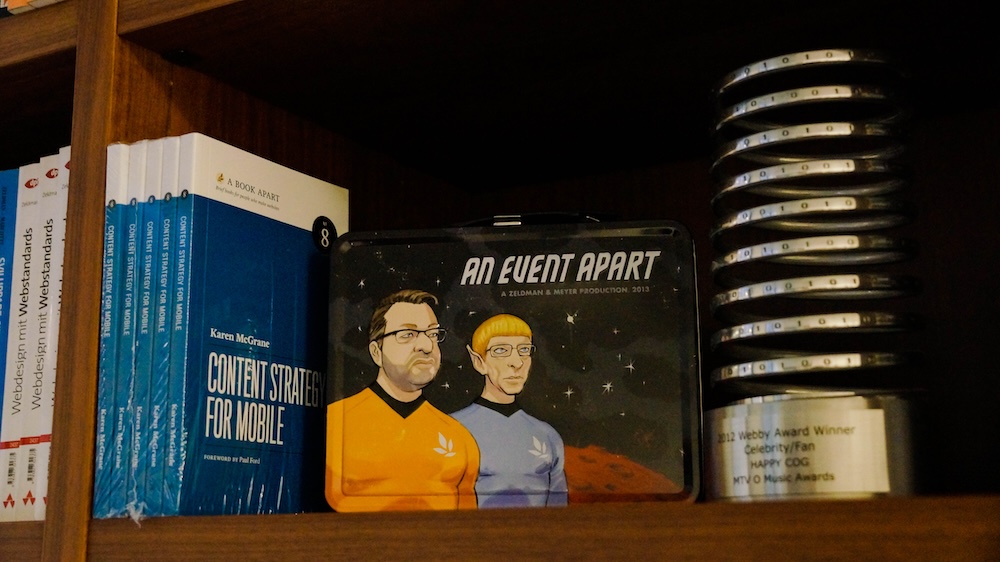
In spite of A List Apart’s running at a loss, in the early 2010s I co-founded two businesses that spun out of it: An Event Apart design conference with Eric Meyer, and A Book Apart with Mandy Brown (later replaced by CEO Katel LeDu) and Jason Santa Maria. And during those first years, business was great.
We published HTML5 For Web Designers the day after Steve Jobs, waving an iPhone on the world’s biggest stage (okay, sitting at his desk), announced that Flash was dead because HTML5 would bring app-like dynamism to the web using open standards instead of proprietary code. It (our first book, I mean) sold brilliantly. “Gee, publishing isn’t that hard” I naively told myself. (No, I knew it was hard. My favorite publishers had been laying off my favorite editors for ten years before my partners and I took the plunge. But the early success did make me think the books we published about web design would always find a large, eager audience. In time, I would learn otherwise.)
And while we began the publishing house by relying on the best writers we knew personally to write about the topics they were most passionate about, I’m proud to say that, as we went along, we also discovered brilliant first-time book authors, helping them create perfectly polished, fluff-free manuscripts that made genuine contributions to our readers’ understanding of UX and all it entails. (And not just to our readers. The insights they brought to their work after digesting our books rubbed off on their colleagues.)
In giving these brilliant writers a platform, we not only helped them take their careers to the next level, we also helped people who create web content think and work better, which in turn helped the people who used the websites, applications, and products our readers designed and built. Of that, I am proud.
Stay hungry
An Event Apart (RIP) was also a damned fine early success. Web designers liked our innovation of a multi-day, single-track conference, with a holistic approach to web design, code, and content, and unifying themes between the individual talks. Our freaking-amazing speakers debuted Huge Ideas including Mobile First and Responsive Web Design—ideas which, like perfect contextual menus in UX, arrived at the very moment designers needed them.
Not only that, but these humble geniuses also sat in the auditorium with our audience for all three days of each conference event: listening to each other’s presentations, and updating their own presentations to better bounce off each other’s ideas and the evolving themes of that particular show.
I could spend hours telling you how our producer Toby M. made miracles happen at every show, or how person-in-charge Marci E. brought joy to our community. How many of our speakers became authors. How some “graduated” from An Event Apart as newcomers replaced them. How the diversity of our speaking line-up, which wasn’t terrific in 2008, improved greatly each year. (Not that we ever said, “We need another black speaker” or “We need a trans speaker” or what-have-you. Just that we learned to swim outside the pool we came from, and discover great talent everywhere.) Our speakers were also almost uniformly Just Nice Good People, which doesn’t always happen when you’re collecting the greatest minds in an industry.
That’s not even to mention the incredible people who attended our shows, some of whom became lifetime friends for me.
So why, given the joy these businesses brought to everyone connected to them, including me, would my partners and I have even conceived of an exit strategy? We wanted the Good Times to roll on forever.
But of course they never do.
Things end
COVID did in An Event Apart. Some conferences survived, of course. Different priorities, different overheads, different business models. Some that survived do not pay their speakers. Others, where the conference is an adjunct to a bigger business, laid off or reassigned conference staff while the pandemic made live events impossible. Others that survived mostly rely on volunteer labor, whereas we had paid staff. They were worth their weight in platinum, and we’d have paid them more (because they were worth more) if the pandemic and six-figure hotel contracts hadn’t made continuing the show impossible. My partner and I earned nothing during the business’s last five years, and got personally stuck with a six-figure debt when the event closed. It is what it is.
Although books should be COVID-proof, multiple financial problems eventually beset our publishing house as well. For most of the run of the business, my partner and I earned nothing beyond the glow of contributing to our community’s knowledge. We paid our CEO, authors, and editors, kept nothing for ourselves, and tried, oh how we tried, to keep the business going as its revenues tanked.
Speaking only for myself, I’ve learned that I am good at starting businesses and keeping them going creatively, as long as somebody else figures out the money. I suck at that, and I’m obsessed with the notions of fairness and self-sacrifice that were drummed into me by a narcissistic family that valued me for taking on the roles they were emotionally incapable of handling—such as bringing up my baby brother in my father’s absence, which no child is equipped or should be asked to do, and yet it happens all the time. Growing up this way made me put my own self-interest last. Which is also why it never occurred to me to plan an exit. And by the time I needed to do so, the businesses were not in shape to sell.
Closing a conference is bad, but attendees can go to other conferences, and speakers can speak at other conferences; closing a conference doesn’t end a community. It sucks for the business but doesn’t strand participants.
But closing a publishing house hurts like hell, and you feel you let everybody down. I know how much our closing hurt some of our authors, and I think about that, instead of the good we achieved, when I look back.
No doubt when my partner and I write the large personal checks to cover our deceased business’s outstanding debts, we’ll be regretting the harm our closing caused, not basking in the warm glow of how many careers we changed for the better. Like the standup comedian who obsesses about the guy who’s frowning at table 3, and doesn’t hear the laughter of the rest of the crowd. We also, hopefully, won’t focus too closely on our financial wreckage. Just pay the bill, and move on.
Anyway, I hadn’t publicly addressed the endings of these businesses, so I figured it was time to do so. I’m sharing my experience only. If you ask any of the people I worked with on these projects, they might have a different story to tell. And that would be their story, and it would be every bit as valid as anything I’ve said here.
I also didn’t ask permission of my partners, speakers, or authors before sharing these thoughts. Probably I should have. But, hey. As I’ve said. I’m speaking here only for myself.
So, anyway.
Parting gift
Is it worth the risk of starting a web-related business that isn’t a venture-backed startup? I still think it is, and I applaud all who try. Heck, I might even do so myself someday. If you’re doubtful because of (((gestures at everything))), it might be worth noting that I started Happy Cog™ during the dot-com crash, when studios were closing all around me. And we launched A Book Apart during the world financial crisis of late 2008. Don’t let (((all this))) deter you from trying something bold. Let me know when you do. I’ll keep watching the skies.
P.S. Under swell third-party ownership and management, Happy Cog is still going strong. Check it out!
My insight into corporate legal disputes is as meaningful as my opinion on Quantum Mechanics. What I do know is that, when given the chance this week to leave my job with half a year’s salary paid in advance, I chose to stay at Automattic.
Listen, I’m struggling with medical debts and financial obligations incurred by the closing of my conference and publishing businesses. Six months’ salary in advance would have wiped the slate clean. From a fiduciary point of view, if nothing else, I had to at least consider my CEO’s offer to walk out the door with a big bag of dollars.
But even as I made myself think about what six months’ salary in a lump sum could do to help my family and calm my creditors, I knew in my soul there was no way I’d leave this company. Not by my own choice, anyway.
I respect the courage and conviction of my departed colleagues. I already miss them, and most only quit yesterday. I feel their departure as a personal loss, and my grief is real. The sadness is like a cold fog on a dark, wet night.
The next weeks will be challenging. My remaining coworkers and I will work twice as hard to cover temporary employee shortfalls and recruit new teammates, while also navigating the complex personal feelings these two weeks of sudden, surprising change have brought on. Who needs the aggravation, right? But I stayed.
I stayed because I believe in the work we do. I believe in the open web and owning your own content. I’ve devoted nearly three decades of work to this cause, and when I chose to move in-house, I knew there was only one house that would suit me. In nearly six years at Automattic, I’ve been able to do work that mattered to me and helped others, and I know that the best is yet to come.
I also know that the Maker-Taker problem is an issue in open source, just as I know that a friend you buy lunch for every day, and who earns as much money as you do, is supposed to return the favor now and then. If a friend takes advantage, you’re supposed to say or do something about it. Addressing these imbalances is rarely pretty. Doing it in public takes its own kind of courage. Now it’s for the lawyers to sort out.
On May 1, 1992, a man who’d been horribly beaten by the L.A. police called for calm in five heartfelt, memorable words: “Can’t we all get along?” We couldn’t then, and we aren’t, now, but my job at Automattic is about helping people, and that remains my focus at the conclusion of this strange and stressful week. I’m grateful that making the tough business decisions isn’t my responsibility. In that light, my decision to stay at Automattic was easy.
P.S. We’re hiring.
They say you should manage down. You’re supposed to manage the people who work for you. For many people who become leads, it’s the toughest and least satisfying part of the job. This is especially true for people who become leads primarily because they’ve been on the job longer than the people around them—not because they had a management jones to satisfy.
They also say you should manage up—subtly assert control of the people you work for. Help them stop short of a bad idea and find their way to a better one. If you can manage up without being obvious about it, you just might save your job, your boss’s job, and your team’s work.
And yet—
Management goes only so far.
The pains of managing up and down are better than the pains of not being able to manage at all. Further, if you swear by managing up or down, I’m not here to discredit you, nor would I dream of doing so, nor would I have cause.
But I am here today to ask you to also try thinking a different way.
Do keep helping people, whether you work for them, work with them, or they work for you.
But don’t think of it as managing them.
Think of it as helping a colleague, just as you’d help a friend, a family member, or (when you’re at your best, and when it’s safe) a stranger.
Help to help, because we’re built to help. We feel better when we do it.
Life is not a contest. At least, it doesn’t need to be chiefly or primarily a contest. If you request feedback and I provide it, what counts is that it helps you. Same when I ask for your help. My position versus yours within this particular hierarchy doesn’t matter. The ideas matter. And the best idea can come from anyone.
Hierarchy matters at times, sure. But not most of the time. Most of the time what matters is showing up, doing your work, and helping others do theirs.
Have a better day!
Ah yes, the famous “intern did it” syndrome
Soon after we launched A List Apart Magazine, we began to notice other websites reusing our content (including illustrations) without permission, and often without so much as a credit. As that violated our author’s copyrights and ours, we’d invariably reach out to the makers of those websites with brief, politely worded takedown requests.
Not every content poacher was contactable, but those we did reach almost always quickly complied with our requests. They also nearly always claimed that an “intern” or “freelancer” had grabbed the content without their knowledge or permission. Some, perhaps fearing that we might be litigious, even went so far as to tell us that they’d “fired” the imaginary intern/freelancer the instant we informed them of the issue.
We always pretended to believe them.
Why? Because letting embarrassed people save face is kind. It also helps the whole interaction go more smoothly. Besides, the amateur pillager claiming “the intern did it” today may be your colleague or friend tomorrow.
I recalled this common awkwardness yesterday after a former US president who’s running for reelection blamed Nazi language in his social media post on a “staffer.” It would seem the buck stops anywhere but here.
This kind of virtuous rising tide rent, which benefits everyone, doesn’t last. Once the growth of the new market slows, the now-powerful innovators can no longer rely on new user adoption and collective innovation from a vibrant ecosystem to maintain their extraordinary level of profit. In the dying stages of the old cycle, the companies on top of the heap turn to extractive techniques, using their market power to try to maintain their now-customary level of profits in the face of macroeconomic factors and competition that ought to be eating them away. They start to collect robber baron rents. That’s exactly what Google, Amazon, and Meta are doing today.
— Tim O’Reilly, Rising Tide Rents and Robber Baron Rents: The Replacement of Organic Search with Advertising by Google and Amazon and What That Might Mean for the Future of AI
See also:
The Man Who Killed Google Search by EDWARD ZITRON: This is the story of how Google Search died, and the people responsible for killing it. (Hat tip: mORA.)
Search Party (2009): Triple Issue No. 292 of A List Apart, for people who make websites, is all about search. By JOHN FERRARA, AVINASH KAUSHIK, and LOU ROSENFELD.
Illustration: Kevin Cornell
This Web of Ours, Revisited
ONE MONTH and 24 years ago, in “Where Have All the Designers Gone?” (my HTMHell design column for Adobe of March 20, 2000), I discussed the deepening rift between aesthetically focused web designers and those primarily concerned with creating good experiences online:
More and more web designers seem less and less interested in web design.
Over the past 18 months or so, many of the best practitioners in the industry seem to have given up on the notion that a low-bandwidth, less than cutting-edge site is worth making. Much of the stuff they’ve been making instead has been beautiful and inspiring. But if top designers wash their hands of the rest of the Web, whose hands will build it, and whose minds will guide it? The possibilities are frightening.
An Imperfect Medium for Perfectionists
Why were many of the leading graphic designers and studios at the time uninterested in web design? For one thing, designers trained to strive for visual perfection found the web’s unpredictability depressing. The article provided clues to the frustrations of the time:
Good designers spend hours tweaking typography in Illustrator and Photoshop. Then visitors with slow connections turn off images.
Of course, where professionals trained in graphic design saw a distressing lack of control, others glimpsed in the infant technology a tremendous potential to help people, pixel-perfection be damned. To reduce the conflict to a cartoon, you might characterize it as David Carson versus Jakob Nielsen—though doing so would trivialize the concerns of both men. Designers already charged with creating websites found themselves somewhere in the middle—barking themselves hoarse reminding clients and managers that pixel-perfect rendering was not a thing on the web, while arguing with developers who told designers the exact same thing.
Visually inspiring websites like K10k showed that the web could, if approached carefully and joyfully, provide aesthetic delight. But many designers (along with organizations like AIGA) were unaware of those sites at the time.
Us and Them
Another source of tension in the medium in 2000 sprang from the discrepancy between the privileged access designers enjoyed—fast connections, up-to-date browsers and operating systems, high-res monitors (at least for the time) offering thousands of colors—versus the slow modems, aging and underpowered computers, outdated browsers, and limited-color monitors through which most people at the time experienced the web.
Which was the real design? The widescreen, multicolor, grid-based experience? Or the 216-color job with pixelated Windows type, a shallow “fold,” and pictures of headline text that took forever to be seen?
To view your masterpiece the way most users experienced it, and at the syrup-slow speed with which they experienced it, was to have an awakening or a nightmare—depending on your empathy quotient. Some designers began to take usability, accessibility, and performance seriously as part of their jobs; others fled for the predictability of more settled media (such as print).
A New (Old) Hope
My March, 2000 article ended on an upbeat note—and a gentle call to action:
For content sites to attain the credibility and usefulness of print magazines; for entertainment sites to truly entertain; for commerce sites and Web-based applications to function aesthetically as well as technically, the gifts of talented people are needed. We hope to see you among them.
That was my hope in 2000, and, all these years later, it remains my vision for this web of ours. For though the browsers, connections, and hardware have changed substantially over the past 24 years, and though the medium and its practitioners have, to a significant extent, grown the Hell up, beneath the surface, in 2024, many of these same attitudes and conflicts persist. We can do better.
Minus the framesets that formerly contained it, you may read the original text (complete with archaic instructions about 4.0 browsers and JavaScript that broke my heart, but which Adobe’s editors and producers insisted on posting) courtesy of the Wayback Machine.
☞ Hat tip to Andrey Taritsyn for digging up the article, which I had long forgotten.
Contrary to what Imran, Ken, and I’m sure many others at Humane believe, the iPhone didn’t begin with their work in the 2000’s on Project Purple. It began in 1976 with the Apple computer, and the decades of goodwill it built up in consumers. The project was spearheaded by a guy ready to waste billions in iPod revenue if it helped achieve his vision, and he answered to nobody. It came together at the perfect point in time, when everyone knew the power of the Internet, but there wasn’t a way to carry the whole experience in your pocket. You can’t replicate all these factors in a few years, no matter how much money a VC throws at you.
Benjamin Sandofsky, Oh, the Humanity: Why You Can’t Build Apple With Venture Capital
Corporations that take investors make an impossible promise to increase profits forever. Accordingly, they hire MBAs whose role is to juggle numbers to create ongoing, short-term profit. This juggling is frequently labeled “leadership.”
The juggling methods—abusing data, diminishing the primacy of the customer relationship, repeating what worked last year as if the demand for it will never end, and perpetually cutting costs—invariably remove value from the company. This, of course, results in more staff and cost cutting.
People who understand the customer and the product are ignored in favor of the number jugglers; research is disparaged in favor of a dogmatic relationship to data.
The people who wreck the company get the big paychecks. Eventually a bigger company buys the first company, further destroying its value. The wreckers exit with more money, 1980s-corporate-raider-style. Skilled workers are laid off, quality plummets, and the cycle begins again.
This picture of a business world with deeply misguided priorities—exemplified by horror stories from the worlds of tech, gaming, and entertainment—is brought to you by Doc Burford, whose discursive post, “the biggest threat facing your team, whether you’re a game developer or a tech founder or a CEO, is not what you think,” takes a while to get through, but is nonetheless worth reading.
It is not a picture of every company, to be sure. But it applies to many, and accounts for much of the worker unhappiness plus customer frustration that characterize this time and contribute to our political unrest.
I wrote this post so you’d know to check that one. Do it.
The dogs won’t eat it
My father used to tell this story to his project management students.
The executives of a dog food company were holding a meeting.
“The new label design tested through the roof!” said the VP of Marketing. “In double blind tests, it outperformed our B and C designs across all demos.”
“Unprompted recall has doubled since our last campaign,” the VP of Advertising chimed in. “Our ‘Share the Love’ theme line has gone viral.”
“‘Dog Mommies’ in key ethnic demos responded favorably to the new, ‘organic’ ingredients,” added the VP of Research. “The ‘fresh chunk of love’ concept is going over like gangbusters.”
“Our new ‘green’ delivery chain efficiencies look like a winner,” said the Director of PR and the Chief Scientist in unison. “We’re a cinch to win Green Co of the Month in Green Business Magazine.”
“So why,” asked the CEO, “are sales trending down?”
The executives looked blankly at one another. Finally the youngest of them spoke up.
“The dogs won’t eat it,” she explained.
No amount of marketing can save a bad product.
Photo by Victor Grabarczyk on Unsplash
WordPress.com is holding its first virtual conference, I’m speaking there, and you’re invited. The WordPress.com Growth Summit is a two-day live event where you can learn to build and grow your site, “from start to scale.” To make it as inclusive as possible, the event will take place twice, with live sessions accessible to all Earth’s time zones:
- In the Americas, Europe, Middle East, and Africa, the conference is August 11-12 from 11:00am–4:00pm EDT (15:00–20:00 UTC).
- For attendees in the Asia Pacific region, the event is August 12-13 from 11:00am–4:00pm JST (02:00–07:00 UTC).
- Can’t attend all of the sessions you’re interested in? No problem. The WordPress.com events team will record them all and make them available to you after the event.
A diverse group of speakers will share tips on creating your site, aligning it to your business goals, finding an audience, building and nurturing an organic fan community, and more.
As for me, I’ll co-host “Blogging and Podcasting: Defining Success” with the amazing Jason Snell. Here’s how we describe our panel:
There are almost as many ways to succeed at blogging and podcasting as there are bloggers and podcasters. In a lively discussion full of plentiful tips and takeaways, industry veterans Jason Snell (The Incomparable, Six Colors) and Jeffrey Zeldman (A List Apart, WordPress.com) will teach you how to:
- Define your mission;
- Craft and govern content;
- Understand and cultivate your audience;
- Maintain authenticity;
- React to change.
You’ll also learn when and how to diversify, and how to make money with paywalls, stores, advertising, and more.
Explore the entire schedule of breakout sessions, demos, keynotes, panels, and talks.
It’s only $79 to attend if you order your ticket by Friday, July 31. On top of which, zeldman.com fans get an additional 20% discount with code Jeffrey20.
After July 31, the ticket price will be $99. So register today.
Posted here for posterity:
Design kickoff meetings are like first dates that prepare you for an exciting relationship with a person who doesn’t exist.
DESIGN WAS so much easier before I had clients. I assigned myself projects with no requirements, no schedule, no budget, no constraints. By most definitions, what I did wasn’t even design—except that it ended up creating new things, some of which still exist on the web. Soon I had requirements, schedules, and constraints, but most of those were self-imposed: for instance, I designed the first A List Apart, published a fresh issue every week, and created title illustrations for every article. This was design, but self-directed. I found it easy and natural and it never felt like work at all.
But then a curious thing happened: I began to get clients. And the more clients I got, and the more complex and sophisticated the projects became, the harder design became for me. I wish I could say I approach design with fearless joy, but the truth is, the longer I do it, the harder and more unnatural it becomes. Starting new projects is easy when you have almost no clue what you’re doing—as easy as playing is for a child. With experience comes knowledge of all the depth and skill you lack. You know how great some design can sometimes be, and how unlikely you are to attain anything resembling greatness on any given project. The very idea of beginning terrifies you.
You work past that, because you’re a professional, but the ease is gone. Maybe it’s just me.
And it isn’t just design. Writing comes naturally to me when I’m expressing myself on my own site, with no outside assignment and no deadline except my own sense of urgency about an idea. It’s easy when I’m crafting a brief text message or tweet. Or a letter to a friend.
But give me a writing assignment and a deadline, and I’m stuck. Paralysis, avoidance, a dissatisfaction with myself and the assignment—all the usual hobgoblins spring immediately to life. I fulfill my assignments, because I’m a professional. Sometimes, once I’m far enough past the initial internal pleading, denial, and bargaining, and have put in the first dull miserable hours of setting one word in front of another like a soldier on a long march through waist-high, rain-drenched mud—sometimes at that dreary midpoint, everything unblocks, and I feel pleasure and clarity as flow returns. That’s what writers on assignment fight for—to reach clarity and naturalness after slogging through the hateful murk.
I also play music, and I’m good at it as long as I’m sitting in a corner at an instrument or console, making stuff up for my own pleasure. But create a commercial music product? Not so much. I once had a small recording studio. I got rid of it. Too much pressure.
You get it.
In my heart I remain an amateur. The spirit of play is where my gifts lie. After 30 years in business I can do the other thing—I can fight through the loneliness to make good product on demand. That is, after all, how I feed my family, and there are many far worse ways to earn a dollar. But it’s never easy. It’s never The Joy.