Once more for the folks in the back. Calibri is easier than Times New Roman for folks with certain visual disabilities to read. That’s why the Biden Administration chose Calibri for their digital communications: to include more people and make life just a wee bit easier for the disabled. And who in their right mind could object to that?
You know who, and they’re not in their right mind—unless you’re talking far-right.
See, to these buffoons, with their narrow zero-sum minds, choosing to meet the needs of the largest number of Americans is the same as withholding special privileges from “real” Americans—straight white men who voted for Trump. That’s what they mean by “woke.” And that’s why, last week, U.S. Secretary of State Marco Rubio directed diplomats to bring back Times New Roman as their official typeface.
Of course it’s petty bullshit, but it’s also deliberately disempowering to the disabled, which is Eugenics at work, which is Nazi stuff—barbaric and cruel. Prove me wrong.
Oh, wait. Let’s ask an expert. Axios quotes Maria Town, president and CEO of the American Association of People with Disabilities:
Ending the State Department’s use of accessible, sans-serif fonts like Calibri is more than a shift in design preferences—it is a direct step backward for millions of people with low vision who rely on digital accessibility features to read vital information.
At a time when families across the country are struggling to afford the basic necessities of life, eliminating accessibility features should be the very last thing our government is concerned with.
So you’d think, if you believe the government exists to help the people. Which, before this presidency, was a reasonable belief, even if previous government services were distributed inequitably and plenty of past administrations had blood on their hands.
But never before has a U.S. administration existed to illegally enrich the president while keeping his convicted felonious ass out of lockup, punishing all but the richest Americans, spurning America’s allies, turning our backs on those around the world who most need our help, and engaging in round-the-clock performative nonsense to satisfy MAGA voters’ thirst for cruelty.
Why write about a font change? After all, this government gets up to many worse things every day. Murder. Kidnapping. Brutality. It’s all too true.
But this one small detail—a typographic change intended to make digital communications just a bit harder for the disabled to read—encapsulates the moronic sadism of this hateful administration.
As Joni told us long ago, you don’t know what you’ve got ’til it’s gone.
We must stop thinking of failure as an end of something, and learn to see it as a natural part of progress. The first incarnation of a new idea may die, but the best ideas will find new lives. Behind every successful launch, there are 100 interesting failures.
My beloved veterinarian’s office apparently moved to a new office location without informing customers. They also changed phone systems. The new phone system doesn’t work, and they didn’t leave a forwarding message on the old phone system. You call, leave a message, never hear back, and never learn what’s become of the business.
Our oldest cat, Snow White, who’s had failing kidneys for two years, is alive at 18 chiefly because we love her and we give her drip medication three times a week. We ran out of the medication last week and requested a refill, but never heard back, and nobody was at the office when we checked.
So for a week I’ve been calling them every morning and every afternoon, while also using their website (which, like the voicemail system, offered not a peep about their office relocation) to request the medicine our queen requires to keep living, and nobody called me back or responded to web messages or text messages, because they weren’t hearing or seeing them.
Today I received a boilerplate email saying that they had moved; the hurried communication included the *area* they moved to but not a street address.
The email also said that their new phone system doesn’t work. So they’ve been sitting in a new office with no customers, not getting their messages—not having thought to provide advance notice to their customers that any changes were afoot—and probably wondering what went wrong.
The email included a phone number we could use to send them a text message. So I did that, letting them know I’d been trying to reach them all week, repeating my request for the badly needed medication, and asking for the street address they’ve moved to.
Three times they texted back with the same information they’d already provided. Information that told the general area they’d moved to. With no street address.
I continued to respond, saying that’s nice but what’s the street address? And each time they replied by resending the same boilerplate that contains absolutely no street address information. You’d think, oh, he’s talking to a bot. But in fact I’m talking to people. People who are responding to messages they’re too frantic to actually read and reply to properly. Instead of answering once, correctly, they end up answering many times without actually, you know, answering.
I empathize with their freakout, I know their job is hard. I had service jobs myself all through my twenties—the benefit of an MFA in fiction writing is that it prepares you to take shit jobs that will later give you material to write about. And even much later in life, as a business owner, I’ve been guilty myself of responding too fast to queries I scanned instead of reading. But I learned better. I learned that it was actually more helpful to read and respond correctly to ten messages, than to scan and respond uselessly to 100.
I know this because one of my former employees would yell at me to slow down. As you may realize, nobody who worked for me ever feared me. Nor did I want them to. I’m happy about that. No boss should intimidate the people who work for them. I made lots of business mistakes—the cliche about creatives not being super-duper at business exists for a reason, and was true for me. But I never made the mistake of encouraging my employees to live in fear. And neither, apparently, does my veterinarian. Which is cool. He is, after all, a good person. The panic driving the thoughtless responses doesn’t come from him, but from the situation.
I’m not angry at anyone—not the brilliant veterinarian who founded the business, not his medical colleagues, and certainly not the folks who run the front desk. But damn. Don’t move without informing your customers. Don’t tell people approximately where you’ve moved to when you finally realize your customers have no idea what happened to your office and you should let them know where you’ve been hiding all week. And if a customer with fair-to-excellent diplomatic skills gently points out that they still need a street address, the thing to do is update your boilerplate to include the street address—not keep resending the useless boilerplate that asks people to treat their pets’ health as a scavenger hunt with exciting clues about where the veterinarian MIGHT be located.
I am an employee myself these days, and happy to be one. I like that everyone at my workplace is available for honest conversation—even the CEO. It’s an unusual and excellent part of our culture.
Dealing with bills and medications and doctors is something I squeeze into short breaks I take during my working day. Today I’m not only dealing with this during those breaks, I’m also trying to coax the staff of a brilliant and expensive gum surgeon I see (I’m old, I have health problems like everybody, and more than some) to send me the records of my many expensive visits there, which I have paid up front (as they required), so I can share those records with my insurance company and possibly get reimbursed. I spent ten days waiting for those records after they promised to send them to me right away. It used to be, doctors sent their bills to the insurer, and if there was any part the insurance company didn’t cover, they’d invoice you later, discreetly. But that hasn’t been The Way of medical treatment in NYC for years, now. I was polite and didn’t bother them about the missing documentation. I only asked twice. I finally got it and submitted it to the insurer. The insurer’s website entered a black hole after I submitted the invoice, because of course it did. So I submitted again. After which, there were two identical invoices in the queue, because of course there were.
So they’ll probably reject them both. As an added bonus, I discovered that the periodontist had sent me two (out of seven) of the bills that they then re-included in the new mega-bill. Which means the insurance company will think I’m fraudulently trying to double-bill them for my expenses. Because of course they will.
Solving writing problems, design problems, and music production problems brings me joy. Dealing with life on life’s terms, not always so much.
The world is on fire and we will see worse before some sense of justice or even normality returns—if it ever does. But me, I’m still worrying about medical bills and where on earth my cat’s lifesaving medical practice has moved to.
Debt brought on by large, unexpected expenses caused me to lose access to my credit card. I’d put a close friend’s storage unit in my name and on my credit card while they relocated and job-hunted. So my payments on my friend’s behalf were no longer going through, and the storage company began texting me about the missed payments.
Sounds straightforward, ordinary, and boring. Turned out not to be.
Meanwhile, my friend—after moving house twice—has landed a terrific job, and is beginning to dig themselves out of their debt. But they can’t pay the full amount of their storage fee yet. Or transfer the unit from my name to theirs.
They tried to make a partial payment by telephone, but the company’s “partial payment” line didn’t work.
It didn’t work in a highly specific way.
Specifically, it let them waste ten minutes entering data by hitting their phone’s keypad and typing “1” after each step to confirm that it had been completed correctly. Finally it asked them to confirm the entire order and type “1” to pay and finish. As soon as they did so, the bot told them that the payment had not gone through … asked them to “wait to speak to a manager” … and immediately disconnected them.
Each time they tried, they got to that stage and were immediately disconnected. With all the goodwill in the world, my friend could not pay their bill. So it was up to me.
“Nothing works” is working as expected.
I had enough cash in the bank to make a full payment on my friend’s behalf; and since the unit was in my name anyway, I followed the company’s text message instructions—sent to me personally—to pay the full bill online on their behalf and set up automated payments for future bills. My friend would pay me back when they could. Eventually we’d transfer ownership. All would be well. Such was my naive hope.
The website let me enter my data step by step, including “new card” data. I removed the defunct credit card info and replaced it with my debit card data. Unlike a credit card, my debit card never lets me spend more money than I have in the bank. That is a good thing when you’re in debt. And even when you’re not. My debit card is with one of the largest banks in the world. If I said the bank’s name, you’d know it. Cole Porter mentioned it in his lyrics. I’ve had the account for over 30 years. In short, it’s a stable account with a long history.
The website allowed me to enter my data, a process that took about five minutes.
When I hit “Send,” the website announced that the payment had failed to go through because the bill was past due.
The system is designed to block payments after first encouraging you to try sending them. There I am, working to send them my money. And the system refuses. Not to put too fine a point on it, consider the facts: their system was designed specifically to let customers make payments. It already knew who I was. It told me my name, my storage unit number, and the amount due. The notes I’d scribbled prior to using the website were unnecessary. The site knew me. It knew what I owed. It was theoretically optimized to take money sans friction. And it failed every time I tried to pay.
Two design choices are worth noting.
The system only accepts timely payments, not late ones. But…
The system deliberately doesn’t tell you that it won’t accept your payment. It encourages you to waste time trying. That’s key.
Is the software poorly designed? Was the company’s QA process less than perfect? Did some sadist deliberately set up the system to punish folks who are struggling?
The answer, of course, is yes. To all three questions.
I tried.
I tried three times, even switching options. Like, the first time, I asked the company NOT to use my debit card number to automatically pay my friend’s bills in the future. The next time, I said, OKAY, go ahead and charge me automatically. No matter which options I chose, the result was always: “The payment did not go through because the amount is past due.”
Who chose those defaults? Elon Musk?
Since the payment website did not accept payments, I called the special “call this number to pay” line the company’s text messages had shared with me. Again, this was a special phone number with a specially built system set up explicitly so existing cutomers could pay their bills by phone.
The number was smart. It had been waiting for my call. It recognized my phone number and told me my storage unit’s account number. It remembered my old credit card number—the one it knows doesn’t work. It asked me if I wanted to pay with the card that doesn’t work. It allowed me to say “No.” It enabled me to enter the account number and other data for my “new” debit card. It encouraged me to type “1” each time I completed a step. It asked me to confirm that everything I’d entered was correct. I did. It asked me to hit “1” one final time to finish making the payment. I did that.
The automated phone voice then informed me that the payment had not gone through, instructed me to “hold the line to speak to a manager,” and immediately disconnected me. Same as what had happened to my friend when they tried to pay.
I tried three times. Each time, the same.
Enter a ton of data by phone. Say yes over and over. Hit the phone equivalent of Send. Get the same error message, followed immediately by disconnection. (Why did I try three times? Why not two? Why not eleven? That’s a QA subject for another day.)
When one door closes, so does another.
Clearly the payment line—like the website—was not working. So I looked up the company’s website to find their main number. Not the smart automated number that knew who I was and what I owed. A dumb number, but presumably with a human being at the other end.
I figured I’d call the main number and explain that I’m trying to pay a bill, have my account number and unit number ready to recite, and all set to approve the dollar amount. If the human being on the other end told me to use the “bill payment number,” I’d explain that the bill payment number wasn’t working at the moment, and ask them to please please pretty please with sugar on top ever so kindly allow me to send them my payment.
So I called and got a busy signal.
Hung up.
Waited ten minutes, called again.
Busy signal.
I’d now wasted at least 30 minutes and it was a work day, so I turned my attention back to my job, and away from nut-grindingly pointless exercises in futility.
After roughly an hour, I tried phoning the company’s main number once again. Busy signal.
Busy, busy, busy. The call never went through. Nobody ever answered.
Here’s what I think: I think if you’re late, this company’s systems stop working. Not because they don’t want your money—they do. But because they want you to suffer for being late. Before they’ll take your money, they want you to crawl. At one time, there was probably a Japanese newsgroup dedicated to this kind of kink. And the beauty part, for the perverted, is that the pain is pointless and nonconsensual. Just like our country’s new government.
The company wants you to try paying them via the payment website till your eyes cross. They want you to dial the “payment” phone number and jump through your own anus until you tire of being disconnected after approving the payment. They want you to weep endless, useless tears. To curse. To try dialing the main number a thousand skrillion times before you get through to a human being. They want you to break down altogether when you finally hear a human voice. Like you’ve been rescued from a desert island and had forgotten the glorious sound of ordinary human speech.
There’s probably a German word for the relief you feel after banging your head against the obtuseness of American business systems until you are finally, after great sorrow, permitted to pay your bill and get back to your life. It’s like the relief you feel when the cable internet finally comes back on after an unexplained blackout. Or when the New York landlord finally fixes the water heater so you can stop washing your private parts in ice water. Or when your trainer finally says, “Good job, let’s go stretch.”
The underlying belief is clear: making a payment should not be routine. It should be a privilege, forged in fire and earned in blood.
Mind you: I don’t know that there actually will be a human being at the end of the phone line if I spend all day Saturday trying to reach one, but, at the moment, that’s my plan. Try and try and try and try and try again and keep trying world without end ad infinitum until at some blessed hour, some stranger finally agrees to take my money.
And here’s the point of all this:
I encounter broken systems like this almost every week.
As a UX person, it makes me nuts. Also as a human being. It’s not right. It’s not fair. And we all put up with it.
Even if you’re lucky enough to have a good job, and even if you live in a progressive city like New York, our increasingly automated business systems are not our friend. In short:
They want to take your job and replace you with a machine that doesn’t work.
This is a test. This is only a test. I’m using WordLand to write this post to my WordPress website. It’s a new, stripped-down writer’s tool for bloggers. Think of it as a frill-free writer’s frontend to the majesty of WordPress. The essential features (and some advanced ones, even) in a distraction-free, scribbler-friendly environment.
## An H2 subhead, my liege.
WordLand supports Markdown, I understand. It also supports direct bolding and links, of course. An overview of the features is available at the link I shared in the opening paragraph. For your convenience, here it is again: https://this.how/wordland/
WordLand doesn’t yet seem to include an affordance for ALT text. Either that, or I couldn’t find the affordance. Pretty likely that that will be corrected soon, as ALT text is a bottom-line basic necessity. (And, again, I may have simply overlooked an existing affordance.)
### An H3 subhead, your worships.
Hmm. More to come. WordLand is a creation of Dave Winer, one of the first bloggers, who also gave us RSS and lots more. Read more about Dave Winer on Wikipedia.
Okay, this was easy enough. For bloggers who mostly *write*, it’s a clean, distraction-free interface with strong basic features that lets you offload CMS duties to WordPress.
Noting that my subheads showed up as text with raw Markdown syntax also presenting as text. This was true even when I stopped writing *##* and replaced it with *h2*, for example. No doubt I’m doing something wrong, and that’s … okay.
I’ve updated this post six or seven times within the WordLand page itself, and the updates flowed seamlessly to the live site.
Update: Make that eight updates I’ve made to this post. 😉 Apparently the editor is WYSIWYG and stores the content in Markdown. I misunderstood the function of Markdown in the app (but I also didn’t carefully read every word of the support docs). Also, there’s supposedly built-in category support using a checkbox system. But I could not find the checkbox widget while using WordLand. That doesn’t mean there isn’t one—but if such an affordance does exist, it would benefit from being made more discoverable.
Many designers still think in px first when creating baseline styles. But we know intellectually that various relative typography approaches are better suited to our medium in all its complexity. Better for accessibility. Better for avoiding bizarre typographic disasters linked to user preference settings, device limitations, and the unforeseen ways our overwrought styles can interact with one another.
As I contemplate a long-overdue redesign of my own site, it’s worth taking a refreshing dip into what we’ve learned about web typography over the past 20+ years. From the pages of (where else?) A List Apart:
Bojan Mihelac: “Power to the People: Relative Font Sizes” (2004)
An early and simple creative solution for text resizing that respects users’ choices and also gives them an additional option for resizing despite the limitations of some of the most popular browsers of the day. Presented for its historical importance, and not as a how-to for today. https://alistapart.com/article/relafont/
Lawrence Carvalho & Christian Heilmann: “Text-Resize Detection” (2006)
Detect your visitors’ initial font size setting, and find out when they increase or decrease the font size. With this knowledge, you can create a set of stylesheets that adapt your pages to the users’ chosen font sizes, preventing overlapping elements and other usability and design disasters. Presented for its historical importance as an insight into the complex dancing we’ve done in the past to ensure readability. https://alistapart.com/article/fontresizing/
Richard Rutter: “How to Size Text in CSS“ (2007)
Sizing text and line-height in ems, with a percentage specified on the body (and an optional caveat for Safari 2), provides accurate, resizable text across all browsers in common use today. An early move toward more responsive type and away from the accessibility problems created by setting text sizes in px in some browsers and devices. https://alistapart.com/article/howtosizetextincss/
Wilson Miner: Setting Type on the Web to a Baseline Grid
The main principle of the baseline grid is that the bottom of every line of text (the baseline) falls on a vertical grid set in even increments all the way down the page. The magical end result is that all the text on your page lines up across all the columns, creating a harmonious vertical rhythm. https://alistapart.com/article/settingtypeontheweb/
“We must now practice a universal typography that strives to work for everyone. To start, we need to acknowledge that typography is multidimensional, relative to each reader, and unequivocally optional.” https://alistapart.com/article/flexible-typesetting/
Keep going…
For more web design community wisdom and web typography history, see Typography & Web Fonts in A List Apart, for people who make websites.
And in the Comments below, please share your favorite resources for creating websites that look great and read beautifully, no matter what technical and human capabilities get thrown at them.
Geisha With Walkman is something I tried to draw 40 years ago, but my rendering skills were simply too poor. The Reve Image 1.0 preview allowed me to do it instantly this morning with a single, basic prompt.
P.S. I retro-updated the Walkman with an iPod to “modernize” the concept.
It’s Sunday; I’m playing with my music collection, content as a fed-and-burped babe. Allow me to explain.
I realized last night that, in tracking my shifting musical tastes via my Last.fm Pro account, I’m basically remaking “Pardon My Icons,” the creative project I launched on this very website in 1995, back when it was still at a tilde address (it did not become zeldman.com until ’96), and which first brought my work to the attention of other creatives who were also discovering the early web and making it their own.
Me, collage, and music
Although I was not serious about it, I started making collage art when I lived in Washington DC in my 20s.
Back then I was serious about composing and producing. I used an Akai 12-track recorder, a rack of synth modules commanded by my Yamaha DX7 with a custom E! card, and a PC running Personal Composer MIDI, arranging, and composition software. I also had an old Selmer Bundy flute, an African reed instrument whose name I forget (and whose “reed” turned out to be a dried locust carcass, as I would discover, to my horror, when the instrument broke), Fender amps, mics, and a variety of percussion instruments with which I made music in my Washington, DC-based recording studio. But that’s a whole ’nother story.
I did not expect to earn a living as a composer, and in that negative expectation I was more than amply fulfilled.
The paper’s arts section editor in those days was named Richard. I’d gotten his attention without soliciting it after creating “Khz” for City Paper. Khz was my weekly music column. I covered the emerging go-go and hardcore scenes, as they were what was happening in DC, and the whole country would soon be listening. Naturally, the Post made me stop writing about that interesting and relevant stuff, and instead paid me $40 per to crank out anodyne concert reviews of mainstream artists like Kenny Rogers when their tours came through DC. (I was comped to the ticket but paid my own travel and gas out of the 40 bucks.)
I typically had 30 minutes from the time the headliner started to call in my review, which meant I had to write it in my head while watching the beginning of the performance, then run to a pay phone booth (kids, ask your parents) and dictate it aloud to someone on the copy desk, before the concert had even begun to build up a head of steam. This wasn’t fair to the artists. I did the best job I could under the circumstances, taking pride in how quickly I could structure and ship a news story. Richard fired me before I could quit, but that, too, is another story.
Most importantly at that time, I lived with a girlfriend. She was an artist and architect who had left that career to study computer programming. We were social (many friends, drinking was often involved), and serious about our art—which, in my case, was music, even if I earned my living writing concert reviews and crafting passable but hardly brilliant ads.
Through all of those ups and downs, and to the side of those major efforts, I kept at the collage for years, putting in several hours a night making the things. When each was finished—and deciding that any art product was finished was damned tough for my restless young mind—I would carefully frame it behind glass, and mount it on the walls of our apartment.
Was it art? Just a hobby? Who knows? It made me happy.
And then gradually, as I put more effort into my music and ad careers, I set the collage-making aside, for a time.
New career in a new town
Ten years later, I was a New York art director and copywriter, two years sober, and no longer in that same romantic relationship. That’s okay, I was in a new one.
I’d packed my music studio equipment—now obsolete because Akai stopped making the proprietary multitrack tape format that their 12-track unit ran on—in a storage unit. Eventually I’d give away all that music and recording equipment (keeping only the multitrack masters), but that, too, is another story.
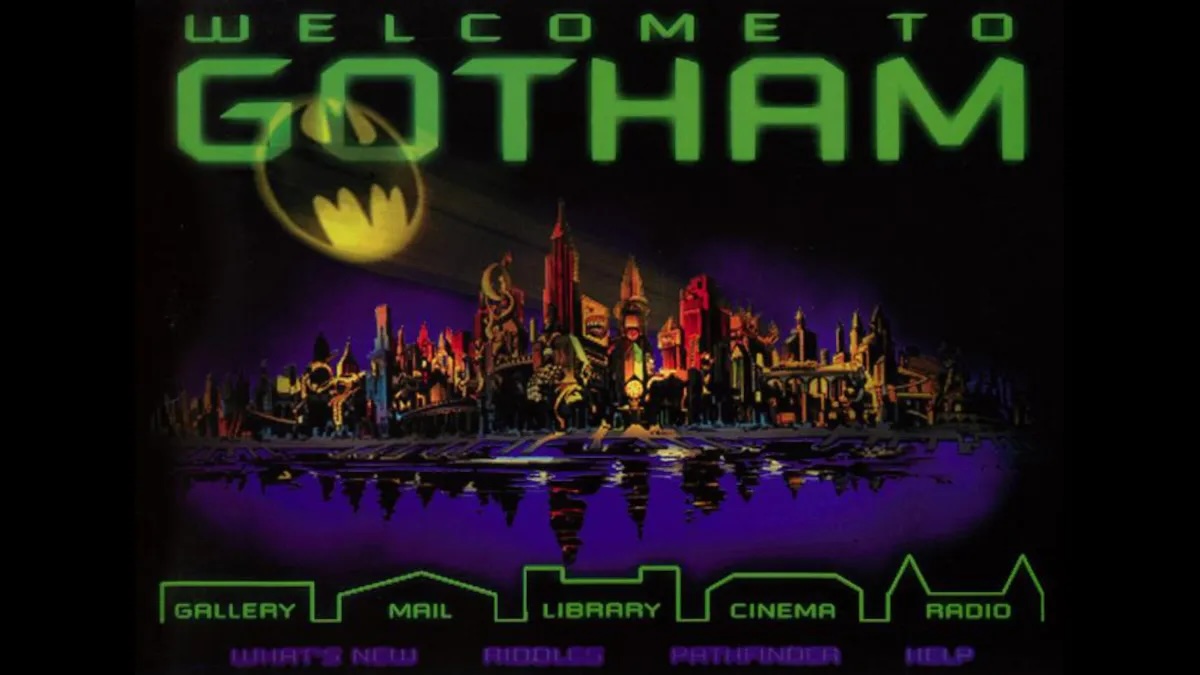
The client was Warner Bros., the project was “Batman Forever,” our visionary client was Donald Buckley, my partners were Steve McCarron, Alec Pollak, and Doug Rice, and the website was a huge hit, attracting half the people who visited the early web. (Alec’s “Flashback 1995: batmanforever” shares screenshots, which are great, although they cannot convey what a breakthrough the site was in March, 1995.)
With 3 million people using the web in 1995, the site got 1.5 million visits a day for over a year. Not bad.
Pardon my icons (1995)
I immediately set to work creating a personal site (this one), and Pardon My Icons was one of its first “entertainments.”
As is often the case with my creative efforts, I made these tiny, Warhol-inflected bits of art as a protest against what I saw as the mediocrity of the icons in general use on that early, early web.
(Similarly, my friends and I would later start The Web Standards Projectin protest against the dumb ways most folks were being told to create websites, e.g. using proprietary tags instead of W3C and ECMA standards, because browsers didn’t properly support those. Having lost access to my musical master tapes because I’d invested in Akai’s non-standard and eventually discontinued tape format, I was kind of keen on not letting the internet fall victim to the same kind of nonstandard f*ckery. But that, too, is another story. We are gathered here to talk about icons and collage. So let’s do that:)
A mental break
I track my music on Last.fm Pro. Here’s my account. (But don’t look unless you, too, have a Pro account. I’ll explain why in a moment.)
Some of the artists I listen to, as shown on last.fm Pro.
Last.fm lists the artists you play, arranging them by the number of plays. Thus, if you were to play three tracks by Freddie Gibbs and two by Bill Evans, you’d have a collage featuring those two artists, with Freddie preceding Bill because he has one more play than Bill.
But if you play three tracks each of Freddie Gibbs and Bill Evans, then Bill will come first, because Bill comes before Freddie alphabetically.
Through such moves, over time, an ever-shifting collage unfolds. But only in Last.fm Pro.
In regular, free old last.fm, you can see other people’s artists as a list, arranged by number of plays, interrupted by an ugly barrage of ads. This is a useful free service for those who are curious about what their friends listen to. But it is a list, not an artful collage, of course.
Collage for days
In Pro, you can see their artists and yours as an ad-free collage that goes on for pages and pages. Plus, as a Pro user, you can choose which photo represents which artist—and even upload your own. When viewing your collection, you and your visitors will see a collage of your favorite artists, in descending order of plays (and with the English alphabet deciding who at each play count precedes whom), using artwork you not only select, but you can also create and upload to the service.
I like Pro. And even though the product isn’t exactly in what you’d call hyper active development—even though the server isn’t always fast, even though there are a few bugs that will probably never get fixed, even though new features are introduced rarely, and the company’s customer service department isn’t exactly the most active help desk in tech—despite those minor drawbacks, the site does things no other website can do. And at US $3, the Pro account isn’t exactly priced out of reach for most customers. (If you can afford a computer, internet access, a music collection and/or a music streaming service, you can probably scratch the 3 bucks together as well.)
How to collage on last.fm
By controlling what I listen to, and the order in which I listen, I’m slowly building an infinite collage of my evolving musical tastes.
By choosing or finding the artist photos (often post-producing them in Photoshop), I create my mood, my rhythm, and my shifting color palettes.
There are design rules governing where portraits should be placed. For instance, people whose face or gaze points rightward get placed on the left of the grid, so they lead the viewer’s eye from left to right, into the composition, whereas those who gaze to my left belong on the right side, leading the viewer’s eye back in.
To reposition someone, I may listen to a few extra plays of them. Or use last.fm’s Pro Admin to subtract a few plays.
When I started using Last.fm, I merely wanted a visual record of what I was listening to, and when I listened. But as you may have inferred, an accurate count of everything I’ve listened to over the past years is no longer my goal in using last.fm; the goal is now the endless collage.
It’s kinda spiritual.
(Reminder: the only way to see it is to be a Pro member of last.fm, which turns off ads and enables you to view your own and other people’s collections in a grid format instead of a list. If you’re a non-member, you see a list jammed with ads.)
If a tree falls, is it art?
Unlike the real-world collages I made in my 20s (which could be mounted on a wall), and unlike 1995’s “Pardon My Icons” (which could be viewed in any browser connected to the web), my current art-making/hobby activity is not publicly viewable except by last.fm Pro users. And that’s okay. ’Cause I’m not designing this for anyone besides myself to enjoy. I mean, if you see it, cool. But if nobody ever sees it, engaging with it will still make me happy.
Which makes this collage business—what? Therapy? Gaming? (Just of a different sort than anybody else?) A form of stimming? It definitely helps lower my general anxiety, providing a space where I can make pretty pictures while listening to my favorite music, which, driven in part by the desire to expand the collage, is widely inclusive and always expanding.
The hunt for fresh collage material also helps keep me interested in new music. (Readers who feel stuck, take note.) And my collage-making, however unimportant it may be, also provides a needed mental health break during these hellish times.
I do this activity every weekend when my more normal friends are biking or baking or dancing.
Is this activity, into which I’ve now poured many hours of my life, artistry or autism? Who cares? The point is that it’s escapist and harmless and we all need some of that in our lives, however we can grab it.
However you grab your moments of calm, meditation, and happiness, never be ashamed of taking care of yourself.
See also…
Rediscovering music: If Spotify exposes you to new music other people are listening to, Last.fm helps remind you of great music in your existing collection that may have slipped your mind.
For love of pixels: Stroll with us down memory lane as we celebrate the pearl anniversary of pixel art creation’s primary progenitor, and some of the many artists and design languages it inspired.
I started using Twitter before the dawn of the iPhone. Back then, in 2006, it was a fun, funky, fully functional (if barebones) beta messaging service used mainly by The People of the Web™—the kind of folks who attended the SXSW Interactive conference and probably spoke on the panels.
You know. You were there. You were one of us: Designers. Developers. Pioneers. Writers of blog posts, trade books, and all the little guide texts that websites depended on to attract and serve their users. People who, in casual conversation, might use words like “digerati” unironically and without intending to be pretentious.
We believed in the power of the web to highlight unheard voices and evolve a more just society. If we were naive, and we surely were, at least we were on the side of the angels. Turns out, not everybody was.
A new skill
Years before Slack, the early 140-character Twitter served as a kind of private pre-Slack for the digitally awake and aware.
Back in those days, if you’d asked me or my conference-going fellow bloggers and designers who that first, rudimentary Twitter was for, we’d have said it was for us. For people like us, who’d spent years mastering all manner of skills and technologies simply to communicate online. Who saw value in the act of putting words together, so long as there were people to read and react to those words.
(After expressing our feelings of pride and ownership in the Twitter community, of course, the more Ted-talk-y among us early users would have waxed rhapsodic about microblogging and its potential to improve the world. More about that in a moment.)
With the birth of Twitter, when we wanted to pin down something that was twitching about in our heads and transmit it to other heads, the skill we needed wasn’t CSS or HTML or art direction or back-end wrangling. It was the ability to edit our thoughts down to a glittering trophy built with 140 characters or less. A new skill to master!
How much do people like us love showing the world what we’ve learned! This much: Even after Twitter no longer relied on wireless carriers’ text messaging services, so that the permitted character count was consequently doubled, many of us would-be Oscar Wildes continued to whittle away at our tweets, limiting them to 140 characters or fewer on principle.
Years later, with a huge international user base, the idea persisted that a globally connected free and open messaging network like Twitter could help humanity do less evil and more good.
If you wanted proof, you could look to the first Arab Spring, to Me Too, to Occupy Wall Street and Black Lives Matter—movements that were greatly abetted by the busy, worldwide network.
Of course, while many cheered and participated in these activist-driven movements, others saw them as threatening. Some felt the world was changing too fast, and that their views on social issues, like their once-good jobs, had no champion among the ruling classes. We all know how that turned out.
And now a brief digression about power and megaphones:
How I got over
Nearly two decades before Bluesky and its sweet starter packs, Twitter hired creatives to recommend selected users to newcomers. Some of the coolest people I know did that work.
Web design was at its peak, so quite naturally the in-house team put together a list of influential designers, developers, and writers for new users to follow. And for a variety of reasons, I was among those early recommended follows. (I may still be listed there, if the current X still welcomes newcomers with follow recommendations.) Which is how, at my Twitter peak, I ended up with a blue checkmark and 355,000 followers.
Even now, on wretched “X,” where I no longer post, I still retain 305,000 followers. At least, that’s what the stats told me when I popped in just now to find out. But are there really that many folks following me there?
How many of my current Twitter/X “followers” used to participate but have since quit quietly, without bothering to close their accounts? Lots, I reckon.
Some may avoid the site but keep their accounts open for strategic reasons, such as preventing someone else from hijacking their name (not that the owner can’t take over your account whenever he feels like it—but I digress).
Mainly, I’m guessing a lot of folks lost interest in the site but forgot to close their accounts. In other words, the data says 305K, but it’s probably less than half that many active users at most, few of whom would even see my tweets if I still posted there, as the algorithm throttles texts from folks like me.
Who cares, besides me? Nobody. Nor should they. And, besides, except as a temptation to stay, my follower count is beside the point.
Come play with us, Danny
The point is that the former Twitter has become a hateful cesspool, not simply mirroring but amplifying its owner’s profound insecurities, god-awful beliefs, and self-serving lies, and forcing that insanity into the public consciousness, whether we avoid X or not.
Thus, millions of Americans who don’t use Twitter/X nevertheless believe conspiracies that the owner and his favorite acolytes use the site to broadcast.
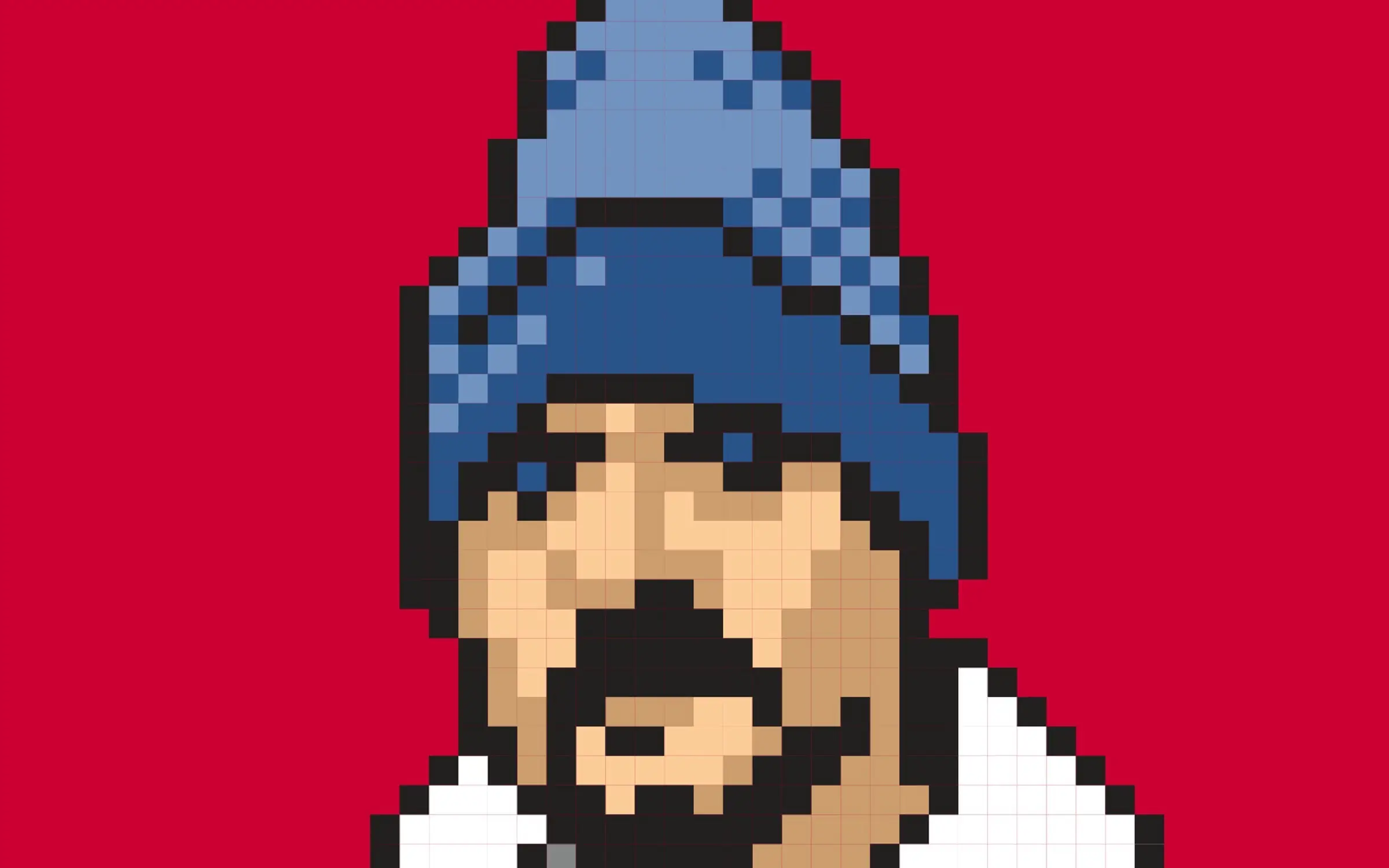
Blue Beanie Day is everywhere! Here astronaut Bowman from 2001: A Space Oddysey flaunts his basic blue toque, couresty of Kevin Cornell (illustration) and Douglas Vos (inventor of the holiday).
Saturday, 30 November 2024, marks the 17th annual Blue Beanie Day celebration. It’s hard to believe, but web standards fan Douglas Vos conceived of this holiday way back in ’07:
The origin of the name of the holiday is the image of Jeffrey Zeldman on the cover of his book wearing a blue knit cap.[7][8][9] Over the years, the Blue Beanie Day also became an action day for web accessibility, for which the correct use of web standards is a basic requirement.[8] — Wikipedia
How can you join this year’s fun? That’s easy! Snap a self-portrait wearing a blue beanie and post your Blue Beanie Day photo to Bluesky, Threads, Instagram, Tumblr, LinkedIn, Facebook, your blog (you’ve still got one, right?), and whatevs. Hashtag: #BlueBeanieDay.
Red, black, and white. Always a good look. Screenshot of The Line website.
If you’re finding today a bit stressful for some reason, grab a respite by sinking into any of these web design inspiration websites.
Gathered from conversations on Reddit and elsewhere, each site offers a collection of other sites’ designs, chosen for impact, originality, and innovation. Each collection should offer at least a few designs that will inspire your own ideas and creativity—and most contain more than a few. Lots more.
We make no claims as to usability, accessibility, or appropriateness of design. Which doesn’t mean that the chosen websites are unusable, inaccessible, or inappropriate to the brand, subject matter, or needs of the audience. Indeed, from the care devoted to the graphical interface, we assume that many of these sites are as good under the hood as they are on the surface. But it’s just an assumption; we haven’t tested, and the point of this post is purely to share visual and creative inspiration. Enjoy!
Zoom has always included a clickable button/badge at the top left of its primary meeting interface window. Click the badge to copy the URL of that meeting. You can then, with just one more click in any messaging system, send that URL to the other meeting participants. Fast. Simple. Drop-dead easy. Elegant.
It comes in especially handy when people didn’t get (or didn’t see or for some reason can’t click on) the meeting link in their invite. Or when the meeting link is hidden behind a tab behind a tab behind a tab in their browser. Or for any of a dozen other reasons you might want to grab the URL of a meeting you’re in, and zap it to a colleague.
How wise are the designers of Zoom to have solved this problem!
And talk about usable! The button’s placement at the top left of the meeting window, with plenty of free open space around it, means that any user (regardless of software experience level) can quickly find the button when they needed it. It’s placed right where your eyes know to look for it.
Good design! Smartly focused on what’s most important to the user.
So, anyway, Zoom seems to have removed the button.
—As I discovered during a Zoom meeting with a colleague 30 minutes ago. (Or, more accurately, a Zoom meeting without that colleague.)
—Who texted me to request the Zoom URL. But I couldn’t send it to them. I couldn’t send it, because I couldn’t see it, because the interface was hiding it.
—Because Zoom has decided to remove that affordance, replacing it with… well, nothing, actually.
It is possible that the affordance still exists somewhere within the Zoom interface, in some gloomily cobwebbed, rarely visited subscreen or other. Possibly with a rewritten label, so that any Zoom customers lucky enough to find it will fail to recognize it, even if staring directly at it with the fixed gaze of an astronomer.
I don’t say Zoom has definitely removed one of the nicest (and possibly, in its humble way, most important) tools their product offered. I don’t say that because I can’t be sure. I merely say, if they haven’t removed this function, they might as well go ahead and do so, for all the good its hidden presence does for Zoom’s millions of users. If the tool is hidden somewhere in the deep background layers of Zoom, I sure couldn’t find it.
So, after wasting time hunting for and texting about the missing Zoom link affordance (here comes the punchline), my colleague and I ended up holding our Zoom call…
… in Google Meet.
If I were a Zoom executive or investor, this might worry me.
Offered with love, UX is hard, and not all decisions are in our hands.
They say you should manage down. You’re supposed to manage the people who work for you. For many people who become leads, it’s the toughest and least satisfying part of the job. This is especially true for people who become leads primarily because they’ve been on the job longer than the people around them—not because they had a management jones to satisfy.
They also say you should manage up—subtly assert control of the people you work for. Help them stop short of a bad idea and find their way to a better one. If you can manage up without being obvious about it, you just might save your job, your boss’s job, and your team’s work.
And yet—
Management goes only so far.
The pains of managing up and down are better than the pains of not being able to manage at all. Further, if you swear by managing up or down, I’m not here to discredit you, nor would I dream of doing so, nor would I have cause.
But I am here today to ask you to also try thinking a different way.
Do keep helping people, whether you work for them, work with them, or they work for you.
But don’t think of it as managing them.
Think of it as helping a colleague, just as you’d help a friend, a family member, or (when you’re at your best, and when it’s safe) a stranger.
Help to help, because we’re built to help. We feel better when we do it.
Life is not a contest. At least, it doesn’t need to be chiefly or primarily a contest. If you request feedback and I provide it, what counts is that it helps you. Same when I ask for your help. My position versus yours within this particular hierarchy doesn’t matter. The ideas matter. And the best idea can come from anyone.
Hierarchy matters at times, sure. But not most of the time. Most of the time what matters is showing up, doing your work, and helping others do theirs.