Fam and I are visiting my 96-year-old Uncle George tonight. We love him. His complicated and somewhat meandering stories have been music to my daughter’s ears since she fell asleep in a cab at age six listening to him lament his wife’s death.
George is my late mother’s only sibling, and the only survivor of that generation, just as I am now the only survivor of my generation of my birth family. I hear my mother’s depression in Uncle George’s stories, and he sees my mother when he looks at me.
A former president of the New York Psychoanalytic Institute (NYPSI) and past medical director of the institute’s Treatment Center, he was still lecturing as recently as October of 2011, when he was a spry and supple 82. He’s a lifelong New Yorker who walks miles every day. I expected him to go on forever. But nobody does.
My cousin told me yesterday that Uncle George may have lost a step or two this year. The thought of that brought my daughter and me to tears.
My mom died fairly young of Alzheimer’s; my dad had untreated dementia for years before my late brother (supported by the Biblical destruction by flood of Dad’s house, and the desertion of Dad’s second wife, who couldn’t take his weekly hospitalizations anymore) managed to get him into a home. He deteriorated there quickly, although he continued to dress each morning as if he were going into the office. He died believing he had beaten up Hitler in a fistfight.
My beautiful younger brother Pete passed soon afterwards, consumed by the worst kind of cancer, and not helped by having exhausted himself worrying about our father.
You never know if the next visit may be the last.
The thought that now Uncle George too is beginning to lose his brilliant mental faculties—and maybe past beginning—is tough to take.
Our culture conspires against preparing for or even acknowledging disability, aging, and death—as if happiness is just one more Amazon delivery away.
I got extra sleep last night and this morning to boost my emotional strength for our visit tonight. Believe it or not, this is me pumping myself up to experience love and joy in tonight’s reunion, and not let sorrow dominate. So much of living now is about finding love and connection while the systems and people we took for granted collapse around us.
My father was an engineer who designed robots. When I first learned what he did, I imagined the Robot from “Lost in Space,” and asked him to make me one. When I turned 13, I realized that the pick-and-place robots he designed replaced assembly-line workers, and asked how he, who’d been a socialist in his impoverished youth, could create something that took anyone’s job away.
“Those are depressing, repetitive jobs,” he said. “Those folks can be trained to do more interesting work: work that stimulates their mind. Pays lots better, too.”
Actually, that’s what he meant to say, but how he expressed it was:
“A steam shovel takes away the job of 1000 Coolies digging with teaspoons. Should we not have steam shovels?”
Oof. My father and his words.
Uh-oh. Let me explain…
My father didn’t mean to be racist with that “Coolie” crack. He was as anti-racist as any white man of his generation, which in his case was actually a lot.
Like he wouldn’t watch “Gone With the Wind” because, in his words, “it’s anti-Negro.”
He would say this angrily, with wet eyes.
As a young man, my father had been a civil rights worker who worked to enroll voters in Harlem. His heart was in the right place.
(But also: He had major emotional problems, constant bubbling rage from untreated childhood trauma, and undiagnosed autism, which made him brilliantly inventive and creative, but which—combined with the broken self-esteem and bottomless pit of rage—left him incapable of speaking for ten minutes without offending someone, often profoundly. Where was I? Oh, yes.)
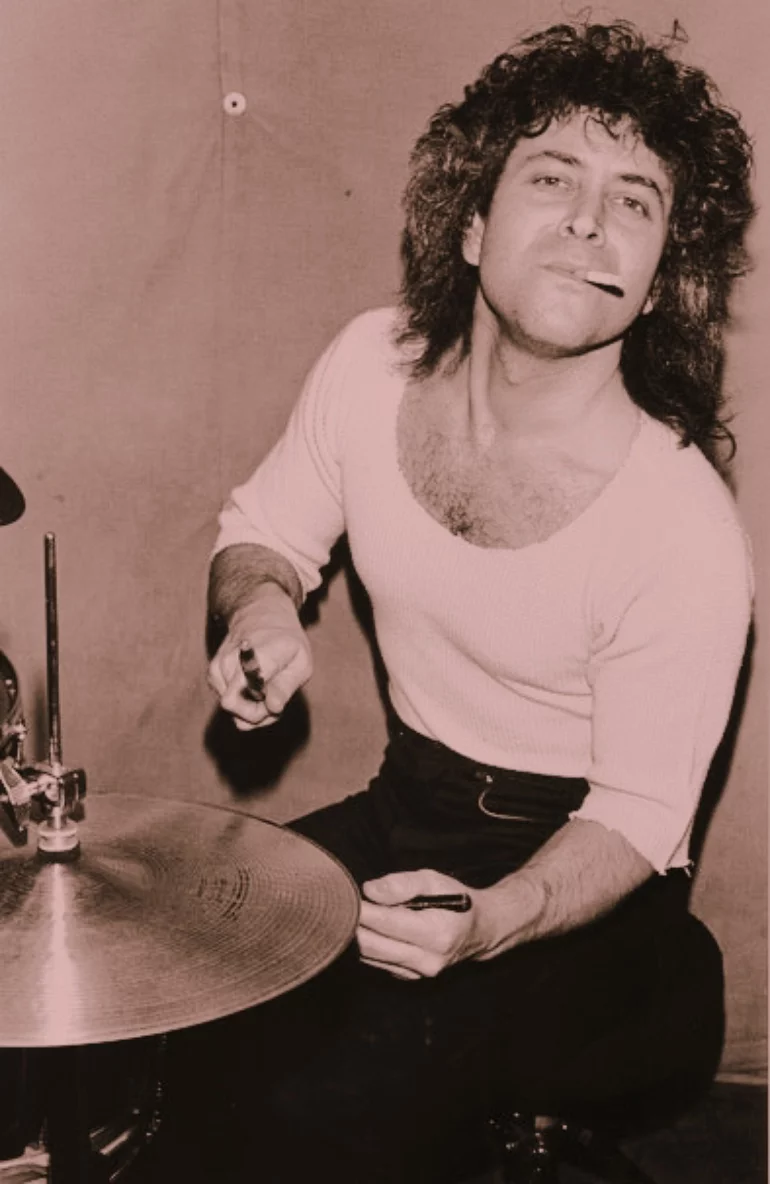
Maurice Zeldman as a young man.
As for the “Negro” in “anti-Negro,” my father was taking his lead from the Black community itself. This was the era of the United Negro College Fund and the NAACP, when a white person calling a Black person a “Negro” was showing respect, strange as it sounds to modern ears.
And he was profoundly right about that damned film, which whitewashed slavery and depicted Black people as either sweet, overgrown children or violent rapists crazed by white flesh. Still later in my life, when cable TV became a thing, it appalled me that Ted Turner played “Gone With the Wind” seemingly every other week on his big channels, TNT and TBS. I’m not saying it’s a badly made or unambitious film. Just that it’s racist af. So fuck Ted Turner. Fuck him for platforming “Gone With the Wind” every ten minutes. Fuck him two times for creating the 24-hour cable news cycle. Look where that’s gotten us.
But I digress.
(NOTE: I can’t watch any film with Clark Gable since I learned that he wore dentures that stank—something his glamorous leading ladies had to endure during dialog and kissing scenes. It’s not that I judge the poor man for his health problems and the state of dentistry in the 1930s. It’s just that, ick, it shatters the romantic illusion movies work so hard to create. But I digress again. I can’t watch “Gone With the Wind” because it is racist, and I’m glad my father gave me that understanding when I was young.)
Beep Boop
Wait a minute, how did I get into all this? I was talking about my dad creating robots for Perkin-Elmer, American Machine & Foundry, and Rockwell International. Robots that didn’t look anything like the talking, beeping 1950s sci-fi robots in the old movies I grew up adoring.
I was talking about how my once-socialist, pro-worker dad helped create products (like pick-and-place robots) that replaced human workers on the assembly line.
Not that that reminds me of anything happening today. Although I should probably ask my chatbot to check and make sure.
(That’s humor, kid—is what my dad would have said.)
Betrayed!
By the way, if you’re so inclined, you can buy a Kindle copy of my dad’s book, “What Every Engineer Should Know about Robots,” from you-know-who. Technically, my father and I wrote the book together: he supplied the knowledge, I brought the writing chops.
When he brought me in on his book-writing assignment, my father promised to share a coauthoring credit with me. But in the end, he couldn’t bring himself to do it. Instead, I was listed in an acknowledgement as a “creative editor,” whatever that means.
I found out when I saw the printed book that I’d been denied my credit.
My dad could have told me in advance. He could have lied and said the publisher insisted on only crediting one author. How would I have known any different? I was only 23.
But he said nothing.
Not that I’m bitter. My dad was profoundly abused in his childhood. While he came across as having a huge ego, inside he was more fragile than silence. To have given me the boost my writing career desperately needed at the time was simply too difficult for him. It needed to be his book, so everyone would know Murray Zeldman was a genius.
At least, that’s what my mother told me when she saw me sitting quietly in a corner, looking like I’d been gut punched.
I have long understood and forgiven my dad, although at the time I could only feel hurt. (Also at the time I was working blue- and grey-collar jobs that barely covered my rent and bus fare; even if it didn’t immediately boost my financial circumstances, it would have been swell for my self-esteem to have the publishing credit I’d earned. But I digress.)
Besides, it was a great learning experience: mindful of the pain I felt when cheated of my credit, I’ve made it a point during my decades of work to always credit my colleagues for their contributions. I hope I have not failed to do that.
But we were talking about chatbots or something. Right?
Say, look here, I’ll tell you what Claude.ai and ChatGPT can’t do: write a memoir as disorganized, digressive, and curdled in the stench of resentment as this here—but what is this thing I’ve written here, anyway? A lament? A word salad dressed in thousand island tears? Who can say? I was dreaming when I wrote this.
My fears melted away. And in their place came acceptance. All this vast majesty of creation. It had to mean something. And then I meant something, too. Yes, smaller than the smallest, I meant something too. To God, there is no zero. I still exist. — The Incredible Shrinking Man (1957)
And also how I feel now that there’s no longer a single, agreed-upon digital town square (and, further, now that the biggest one, where I once enjoyed a hefty following for some pixel pusher, has turned into a N*zi bar, where I no longer choose to spend time).
And since Covid killed the conference I co-founded, and I cut way back on travelling and giving conference talks and focused on paying off the debts we were left with.
And since financial reality forced us to kill our publishing company, too. So many nice things, all gone.
I had the world, or at least a wee piece of it, by the eyeballs, and, not entirely by my own choice, bit by bit, I let it go.
Kinda depressing, sure. But also, and mainly, pretty liberating.
I also learned something about people and friendship, and remembered something about the passing of all things.
My doctor sends me to Brooklyn for an abdominal aortic aneurysm screening. As instructed, I fast for six hours beforehand. I don’t even brush my teeth, for fear of swallowing toothpaste and screwing up the test. I wear a Covid-era face mask to avoid breathing on anyone.
The journey takes me to Boro Park, a part of the city I’d not explored before. Judging by the style of pedestrian dress and the Hebrew lettering on some of the buildings, it appears to be an Orthodox Jewish neighborhood.
I enter an enormous, shabby waiting room—empty except for me, a receptionist, and a warehouse’s worth of old furniture. The couches are patched with duct tape. There are signs on the tables forbidding you to sit on them. The receptionist informs me that I can in fact drink water without spoiling the test results. She gives me a cup.
After some minutes, a technician comes for me. She’s soft-spoken and quietly friendly. Wears a pink headband and a long dress.
The examination room and the equipment inside it remind me of OB/GYN visits when my ex was pregnant. In those tests, we wanted to see something. In this test, I suppose, we do not. I lie on my back. The jelly is cold.
The exam takes 40 minutes. The only point of visual interest in the somehow-coffee-stained drop ceiling above me is a circular, flat light fixture composed of concentric glass rings. It is like the eye of God, peering down at me. Not a personal, loving God, mind you. Or maybe it’s more like the hard stare of a universe that, if it took note of our trivial human suffering, would be indifferent to it. I breathe in and out, as instructed.
The technician takes several dozen pictures. There’s sound, too. Occasionally I hear the roar my blood vessels make, chugging busily. My blood vessels don’t share my worries. They just do their work. Some of the sounds they make are rather rude. I suppose that’s good. I like to think the boys in the engine room are somewhat boisterous. The rudeness sounds like health.
It’s time to stop staring at the light, sit up, and wipe the goo off my belly. The technician gives me a large piece of special medical paper designed for this very task.
After I leave, a radiologist will review the pictures and send a report to my doctor.
I have a half-dozen other tests to take in the next few weeks. X-Rays, scans, even a lung screening. Ordinarily when a doctor recommends a half-dozen tests, I shove the paperwork in a corner of my desk and forget about it. But this time, I decided to be an adult and follow through. I may even balance my checkbook one day.
I exit the mostly empty medical facility, call a Lyft, and stand on the sidewalk a while, taking in Boro Park. On the ride home, I let my gaze caress the changing neighborhoods. Somehow the whole city seems more interesting. Or maybe more alive. Like air after rain. Even the familiar landmarks as I near home strike me as beautiful and reassuring.
Home again, I wash my hands, clean last night’s dishes—the kid and her boyfriend cook late at night—pour my first espresso of the day, and knock it back with plenty of fresh, cold water.
I text my friend, to whom I’d complained earlier about the instructions against tooth brushing. He asks, “Did they give you a mint?” I respond with a “ha-ha” emoji.
Much as I enjoy my job, am grateful for my health insurance, and appreciate the wonders of modern medicine, I decide to take the rest of the day off. You know, for mental health.
Debt brought on by large, unexpected expenses caused me to lose access to my credit card. I’d put a close friend’s storage unit in my name and on my credit card while they relocated and job-hunted. So my payments on my friend’s behalf were no longer going through, and the storage company began texting me about the missed payments.
Sounds straightforward, ordinary, and boring. Turned out not to be.
Meanwhile, my friend—after moving house twice—has landed a terrific job, and is beginning to dig themselves out of their debt. But they can’t pay the full amount of their storage fee yet. Or transfer the unit from my name to theirs.
They tried to make a partial payment by telephone, but the company’s “partial payment” line didn’t work.
It didn’t work in a highly specific way.
Specifically, it let them waste ten minutes entering data by hitting their phone’s keypad and typing “1” after each step to confirm that it had been completed correctly. Finally it asked them to confirm the entire order and type “1” to pay and finish. As soon as they did so, the bot told them that the payment had not gone through … asked them to “wait to speak to a manager” … and immediately disconnected them.
Each time they tried, they got to that stage and were immediately disconnected. With all the goodwill in the world, my friend could not pay their bill. So it was up to me.
“Nothing works” is working as expected.
I had enough cash in the bank to make a full payment on my friend’s behalf; and since the unit was in my name anyway, I followed the company’s text message instructions—sent to me personally—to pay the full bill online on their behalf and set up automated payments for future bills. My friend would pay me back when they could. Eventually we’d transfer ownership. All would be well. Such was my naive hope.
The website let me enter my data step by step, including “new card” data. I removed the defunct credit card info and replaced it with my debit card data. Unlike a credit card, my debit card never lets me spend more money than I have in the bank. That is a good thing when you’re in debt. And even when you’re not. My debit card is with one of the largest banks in the world. If I said the bank’s name, you’d know it. Cole Porter mentioned it in his lyrics. I’ve had the account for over 30 years. In short, it’s a stable account with a long history.
The website allowed me to enter my data, a process that took about five minutes.
When I hit “Send,” the website announced that the payment had failed to go through because the bill was past due.
The system is designed to block payments after first encouraging you to try sending them. There I am, working to send them my money. And the system refuses. Not to put too fine a point on it, consider the facts: their system was designed specifically to let customers make payments. It already knew who I was. It told me my name, my storage unit number, and the amount due. The notes I’d scribbled prior to using the website were unnecessary. The site knew me. It knew what I owed. It was theoretically optimized to take money sans friction. And it failed every time I tried to pay.
Two design choices are worth noting.
The system only accepts timely payments, not late ones. But…
The system deliberately doesn’t tell you that it won’t accept your payment. It encourages you to waste time trying. That’s key.
Is the software poorly designed? Was the company’s QA process less than perfect? Did some sadist deliberately set up the system to punish folks who are struggling?
The answer, of course, is yes. To all three questions.
I tried.
I tried three times, even switching options. Like, the first time, I asked the company NOT to use my debit card number to automatically pay my friend’s bills in the future. The next time, I said, OKAY, go ahead and charge me automatically. No matter which options I chose, the result was always: “The payment did not go through because the amount is past due.”
Who chose those defaults? Elon Musk?
Since the payment website did not accept payments, I called the special “call this number to pay” line the company’s text messages had shared with me. Again, this was a special phone number with a specially built system set up explicitly so existing cutomers could pay their bills by phone.
The number was smart. It had been waiting for my call. It recognized my phone number and told me my storage unit’s account number. It remembered my old credit card number—the one it knows doesn’t work. It asked me if I wanted to pay with the card that doesn’t work. It allowed me to say “No.” It enabled me to enter the account number and other data for my “new” debit card. It encouraged me to type “1” each time I completed a step. It asked me to confirm that everything I’d entered was correct. I did. It asked me to hit “1” one final time to finish making the payment. I did that.
The automated phone voice then informed me that the payment had not gone through, instructed me to “hold the line to speak to a manager,” and immediately disconnected me. Same as what had happened to my friend when they tried to pay.
I tried three times. Each time, the same.
Enter a ton of data by phone. Say yes over and over. Hit the phone equivalent of Send. Get the same error message, followed immediately by disconnection. (Why did I try three times? Why not two? Why not eleven? That’s a QA subject for another day.)
When one door closes, so does another.
Clearly the payment line—like the website—was not working. So I looked up the company’s website to find their main number. Not the smart automated number that knew who I was and what I owed. A dumb number, but presumably with a human being at the other end.
I figured I’d call the main number and explain that I’m trying to pay a bill, have my account number and unit number ready to recite, and all set to approve the dollar amount. If the human being on the other end told me to use the “bill payment number,” I’d explain that the bill payment number wasn’t working at the moment, and ask them to please please pretty please with sugar on top ever so kindly allow me to send them my payment.
So I called and got a busy signal.
Hung up.
Waited ten minutes, called again.
Busy signal.
I’d now wasted at least 30 minutes and it was a work day, so I turned my attention back to my job, and away from nut-grindingly pointless exercises in futility.
After roughly an hour, I tried phoning the company’s main number once again. Busy signal.
Busy, busy, busy. The call never went through. Nobody ever answered.
Here’s what I think: I think if you’re late, this company’s systems stop working. Not because they don’t want your money—they do. But because they want you to suffer for being late. Before they’ll take your money, they want you to crawl. At one time, there was probably a Japanese newsgroup dedicated to this kind of kink. And the beauty part, for the perverted, is that the pain is pointless and nonconsensual. Just like our country’s new government.
The company wants you to try paying them via the payment website till your eyes cross. They want you to dial the “payment” phone number and jump through your own anus until you tire of being disconnected after approving the payment. They want you to weep endless, useless tears. To curse. To try dialing the main number a thousand skrillion times before you get through to a human being. They want you to break down altogether when you finally hear a human voice. Like you’ve been rescued from a desert island and had forgotten the glorious sound of ordinary human speech.
There’s probably a German word for the relief you feel after banging your head against the obtuseness of American business systems until you are finally, after great sorrow, permitted to pay your bill and get back to your life. It’s like the relief you feel when the cable internet finally comes back on after an unexplained blackout. Or when the New York landlord finally fixes the water heater so you can stop washing your private parts in ice water. Or when your trainer finally says, “Good job, let’s go stretch.”
The underlying belief is clear: making a payment should not be routine. It should be a privilege, forged in fire and earned in blood.
Mind you: I don’t know that there actually will be a human being at the end of the phone line if I spend all day Saturday trying to reach one, but, at the moment, that’s my plan. Try and try and try and try and try again and keep trying world without end ad infinitum until at some blessed hour, some stranger finally agrees to take my money.
And here’s the point of all this:
I encounter broken systems like this almost every week.
As a UX person, it makes me nuts. Also as a human being. It’s not right. It’s not fair. And we all put up with it.
Even if you’re lucky enough to have a good job, and even if you live in a progressive city like New York, our increasingly automated business systems are not our friend. In short:
They want to take your job and replace you with a machine that doesn’t work.
Editor’s Note || Our New York apartment is home to three humans and three cats: Snow White, Mango, and young Jasper.
Woke to pee 2:00 am. Entered bathroom. Narrowly avoided slipping on a small lake of Snow White’s urine. Beheld a giant fat shit she’d left on the stone bath mat. It was like the cinema sequence, underscored by dissonant trumpets, where the heroine realizes she’s entered a chamber of horrors.
Instead of screaming, I turned on the faucet so Snow White, who had followed me into the bathroom, could hop onto the sink and drink from the tap.
She’s 17, so by “hop” I mean climb at a moderate pace from floor to toilet seat to toilet tank to sink. (17 also explains why she has recently begun drinking exclusively from the bathroom taps, and excreting outside the litter box. And why I accept living with it. Acts of kindness are no guarantee of karmic reciprocity, but I can hope that when I’m Snow White’s equivalent age, someone will smilingly tolerate my dotty incontinence.)
By now, young Jasper had awoken and followed us in, so I spent a fast hand-waving minute guiding his sleek bullet-fast frame away from Snow White’s award winning turd, which had arrested his curiosity.
After Jasper skedaddled, and while Snow White was still busy sipping from the sink, I sprayed and mopped the floor.
Scooped up the giant shit.
Wiped down the place where it had been.
Washed my hands.
Finally, peed.
Washed my hands again.
Looked to see if the floor was dry. Semi. Good enough.
Laid a fresh dry giant wee wee pad on the damp but clean floor. Started to pick up the previously used wee wee pad, which one of the cats had folded into a sopping origami. As my fingers approached the wet paper, my skin somehow sensed how drenched it was. I left it where it lay.
Snow White, having sipped her fill, climbed down from the sink and glided away.
I left the damp origami to the side of the dry, newly laid wee wee pad and departed the chamber of secrets.
Somehow it had become 3:00 am. I heard the kids chatting in their room, so sent them a friendly middle of the night text: “Hi, fart heads.” Then I wiped my feet and climbed back into bed.
But sleep did not come. So I picked up my phone and pecked into it the words you’ve just read.
It is 3:52 am and I’m thinking I need to make an espresso and start the day. Good morning!
My father, Maurice Zeldman, was a giant in the field of project management, though I suspect few in my world of web standards and design would recognize his name. Dad consulted for over 180 organizations and led seminars around the world. Project managers everywhere used his techniques to create realistic estimates and timelines that actually worked—a rare skill in any technical field, then and now.
Before founding EMZEE Associates (the name a play on his initials, M.Z.), Dad was Corporate Director of Technical Development for Rockwell International’s Industrial & Marine Divisions. He designed, built, and staffed their entire Engineering Development Center. Earlier in his career, he worked with Perkin Elmer developing an Atomic Absorption Spectrometer and with American Machine & Foundry as Chief Engineer of their Versatran Robot division. His robotics knowledge led to his book Robotics: What Every Engineer Should Know, published by CRC Press in 1984, followed by Keeping Technical Projects on Target, an AMA management briefing.
EMZEE Associates, Dad’s consulting and training company, specialized in project management and technology implementation. While I was designing websites and campaigning for web standards in the mid-90s, Dad was already running a successful business teaching Fortune 500 companies how to bring their complex technical projects in on time and under budget.
Then there was ZGANTT, his DOS-based project management software from the late 80s/early 90s. The name combined “Zeldman” with “Gantt chart—those horizontal bar charts showing project schedules that are still used today. While I was learning to code and finding my path, Dad had already created specialized software implementing his project management methodologies. This was during the first wave of specialized project management tools, before Microsoft Project took over the market.
Looking back, I realize my obsession with systems, standards, and improving how people work together didn’t come from nowhere. While I applied these principles to web design, Dad had been applying similar thinking to the complex world of project management decades earlier. His ZGANTT software and EMZEE Associates consultancy were direct expressions of his belief that the right methods, correctly implemented, could bring order and success to even the most complex technical challenges.
Beloved reader, I spent 90 minutes on hold with Con Edison yesterday, getting my power turned back on after a billing contretemps.
The whole 90 minutes, my brain’s shrieking, “You’re having a panic attack!”
And maybe I was.
I could rattle off my diagnoses, but the simplest way to state it is that the ordinary setbacks of life fill me with dread. Always have. For over a decade, I self-medicated daily. And nightly. And afternoonly. In 1993, with help from others, I changed my life’s trajectory. But removing the booze didn’t make me “normal.” Step work healed some old wounds, but I’m still deeply anxious on my best days. And this was not shaping up to be one of them.
Look, if recovering from alcoholism during the Clinton years didn’t magically cure me of the rest of my problems, you can imagine what it feels like, being me during these dark days of fascist overreach. And, hey, maybe you don’t need to imagine. Maybe every blank unholy news day feels scary, wrong, and depressing to you, too. No need to apologize. Some days, just showing up takes courage.
Even the positive things, like the kick-ass job my daughter did applying to colleges, come with deluxe boxed sets of anxiety for folks like me. Then factor in an IRS audit, medical debt, and various friend and family traumas unrelated to the ongoing assault on decency.
Got all that?
Now, take away my electricity (and therefore my internet access), sit me down in the dark beside an iPhone with a low battery (Will it die before I finish this call? I can’t charge it, I have no electricity!), and tell me to get on the phone with the utility company that just shut off my power.
You may expect me to show up, but not to glide serenely through.
Look, I wasn’t abducted by ICE or fired without cause after years of dedicated civic service. But, for Mrs Zeldman’s little boy, loss of light and power and 90 minutes of antipatterns are grounds enough for a panic attack. (Besides, nobody tells you it will take 90 minutes to speak for 60 seconds to a human being who’ll take your debit card number over the phone. It might have taken longer. In another timeline, I might still be on hold.)
Yes, they have a “pay your bill online” website. No, it doesn’t work on my phone. Yes, it semi-works on my desktop. But a desktop needs electricity to run and to access the web. And they had cut off my electricity. It was call them or stay without power.
(Footnote: Later, when everything was resolved, I discovered that their website also doesn’t work. I use Google’s Auth app for two-factor ID, which signs me in. But when I try to see my bill, the Con Ed website asks me to sign in again, and rejects the two-factor ID. Instead it needs to send a different code to my cell phone. Why a different code? Why not the Auth code? I assume because the developers worked in siloes and were forbidden to speak to each other when creating the website. So I give it permission to send the code to my phone, and then it never sends it. I tried four times. And yes, they had my correct phone number on file. It also says, if it keeps failing to send a code to my phone (so they obviously know they have a problem), I can have it send a code to my email address instead. Except that there is no affordance to do so. It’s like if I said you could win a prize by touching this sentence. Heckuva UX, Brownie. It’s almost like they want you to have to call their overworked, underpaid, understaffed support staff. Because you can’t use their site. To rub it in, every five minutes the bot that thanks you for being a customer is interrupted by a bot that tells you to use their website to pay your bill online, which, as I just explained, you can’t. But I digress.)
As the Muzak ground on, during the better moments when I was able to focus on breathing, I pushed down the panic by telling myself I’d take a personal day as soon as the call ended and my lights came back on. Why take a personal day? I love my job. But I honestly didn’t think I’d be able to put in a day’s work after 5400 seconds of “your call is important to us, please stay on the line.” I reckoned I’d be wrecked.
But here’s the thing, and it’s why I bothered tell you this: the instant the lights came back on, I was fine. Utterly, totally, calmly, and completely.
More than that: when the modem connected and told the router the news, I pounced on my desk and got back to work, a happy cog. As if I hadn’t just spent 90 minutes in the stench of my own fear and gloom.
A whinnying horse. A blaxploitation sample. A female instructor saying Chinese is the easiest language to learn. These three brief audio samples regularly interrupt my late-night headphone music listening.
I’m not tripping or having a medical episode. My bedroom faces the rear of the Chinese Mission to the UN. I can’t be certain that these unwelcome late-night audio interruptions come from there, but it’s a theory. If you’ve never fallen gently asleep to a bespoke playlist of jazz ballads, only to sit bolt upright in terror an hour later because a horse is shrilly whinnying in your ears, you should try it some time.
The bullies who beat and mocked me in eighth grade were cruel and stupid. They despised intelligence and worshipped violence, although they would settle for athletic ability. The school blessed their thuggery by scheduling dodgeball. It was good preparation for Viet Nam, the country where I expected to be blown apart if I managed to survive to eighteen.
If you were smart in eighth grade, you were also a fag. I don’t even think they meant you were actually queer. I think it was just one of the worst things a bully could call you before pounding on you. Indeed, it lent an aura of righteousness and inevitability to the beatings that got doled out to you. Surely all red-blooded American boys would want to beat up fags! And who could blame them? Not the schools. Not the churches. And certainly not the cops. Why, it was practically a young man’s duty to rid the world of insufficiently macho peers. A kind of post-birth eugenics, if you will.
The other word the bullies used for me was pussy, because they could imagine nothing lower than a woman, I suppose. They even called me Zeldwoman.
I’d been picked on in the seventh grade, in Connecticut, too, but that was mostly by my pals, who were possibly just busting balls, something they’d have learned to do (and I had not) over the previous year’s summer break. My friends’ taunts once made me cry in school, which was unforgivable in a boy, so I would have been destroyed had we stayed in Connecticut, anyway. But we moved.
And the Pittsburgh of those years was worse for me. In the end, I survived eighth grade in Pittsburgh because I could crack jokes and write and draw what were called underground or head comics at the time, and one of the toughest kids in the school thought I was funny and let me hang out with his gang. They were called the Garage Gang, and they probably had roots in preadolescent group onanism, but by the time I joined as a sort of amusing mascot, they were mostly about smoking, shoplifting, stealing beer, making out with girls, and buying and selling pot and psychedelics. Eventually I would become a dealer myself, and hang with the freaks instead—smart kids who made art and got high a lot. This enabled me to survive until I was old enough to go college and reinvent myself.
I don’t know why I’m thinking about these things again lately. It’s not like America’s most vulnerable citizens are being targeted by a hostile, mentally retrograde government. Not like bullies, racists, and homophobes everywhere have been set free to revert to their ugliest selves by a mentally deficient ringleader who knows how to whip up a crowd and feed their hunger for violence as a screen behind which he robs us all. Of our money, of course. But more importantly of our rights, our dignity, our ability to accept one another and celebrate our differences instead of masking them. Most of all, the bullying crowd is robbing us of the more perfect union many of us hoped America was beginning to achieve. But, hey. How ’bout that Gulf of America. Winning.
It’s Sunday; I’m playing with my music collection, content as a fed-and-burped babe. Allow me to explain.
I realized last night that, in tracking my shifting musical tastes via my Last.fm Pro account, I’m basically remaking “Pardon My Icons,” the creative project I launched on this very website in 1995, back when it was still at a tilde address (it did not become zeldman.com until ’96), and which first brought my work to the attention of other creatives who were also discovering the early web and making it their own.
Me, collage, and music
Although I was not serious about it, I started making collage art when I lived in Washington DC in my 20s.
Back then I was serious about composing and producing. I used an Akai 12-track recorder, a rack of synth modules commanded by my Yamaha DX7 with a custom E! card, and a PC running Personal Composer MIDI, arranging, and composition software. I also had an old Selmer Bundy flute, an African reed instrument whose name I forget (and whose “reed” turned out to be a dried locust carcass, as I would discover, to my horror, when the instrument broke), Fender amps, mics, and a variety of percussion instruments with which I made music in my Washington, DC-based recording studio. But that’s a whole ’nother story.
I did not expect to earn a living as a composer, and in that negative expectation I was more than amply fulfilled.
The paper’s arts section editor in those days was named Richard. I’d gotten his attention without soliciting it after creating “Khz” for City Paper. Khz was my weekly music column. I covered the emerging go-go and hardcore scenes, as they were what was happening in DC, and the whole country would soon be listening. Naturally, the Post made me stop writing about that interesting and relevant stuff, and instead paid me $40 per to crank out anodyne concert reviews of mainstream artists like Kenny Rogers when their tours came through DC. (I was comped to the ticket but paid my own travel and gas out of the 40 bucks.)
I typically had 30 minutes from the time the headliner started to call in my review, which meant I had to write it in my head while watching the beginning of the performance, then run to a pay phone booth (kids, ask your parents) and dictate it aloud to someone on the copy desk, before the concert had even begun to build up a head of steam. This wasn’t fair to the artists. I did the best job I could under the circumstances, taking pride in how quickly I could structure and ship a news story. Richard fired me before I could quit, but that, too, is another story.
Most importantly at that time, I lived with a girlfriend. She was an artist and architect who had left that career to study computer programming. We were social (many friends, drinking was often involved), and serious about our art—which, in my case, was music, even if I earned my living writing concert reviews and crafting passable but hardly brilliant ads.
Through all of those ups and downs, and to the side of those major efforts, I kept at the collage for years, putting in several hours a night making the things. When each was finished—and deciding that any art product was finished was damned tough for my restless young mind—I would carefully frame it behind glass, and mount it on the walls of our apartment.
Was it art? Just a hobby? Who knows? It made me happy.
And then gradually, as I put more effort into my music and ad careers, I set the collage-making aside, for a time.
New career in a new town
Ten years later, I was a New York art director and copywriter, two years sober, and no longer in that same romantic relationship. That’s okay, I was in a new one.
I’d packed my music studio equipment—now obsolete because Akai stopped making the proprietary multitrack tape format that their 12-track unit ran on—in a storage unit. Eventually I’d give away all that music and recording equipment (keeping only the multitrack masters), but that, too, is another story.
The client was Warner Bros., the project was “Batman Forever,” our visionary client was Donald Buckley, my partners were Steve McCarron, Alec Pollak, and Doug Rice, and the website was a huge hit, attracting half the people who visited the early web. (Alec’s “Flashback 1995: batmanforever” shares screenshots, which are great, although they cannot convey what a breakthrough the site was in March, 1995.)
With 3 million people using the web in 1995, the site got 1.5 million visits a day for over a year. Not bad.
Pardon my icons (1995)
I immediately set to work creating a personal site (this one), and Pardon My Icons was one of its first “entertainments.”
As is often the case with my creative efforts, I made these tiny, Warhol-inflected bits of art as a protest against what I saw as the mediocrity of the icons in general use on that early, early web.
(Similarly, my friends and I would later start The Web Standards Projectin protest against the dumb ways most folks were being told to create websites, e.g. using proprietary tags instead of W3C and ECMA standards, because browsers didn’t properly support those. Having lost access to my musical master tapes because I’d invested in Akai’s non-standard and eventually discontinued tape format, I was kind of keen on not letting the internet fall victim to the same kind of nonstandard f*ckery. But that, too, is another story. We are gathered here to talk about icons and collage. So let’s do that:)
A mental break
I track my music on Last.fm Pro. Here’s my account. (But don’t look unless you, too, have a Pro account. I’ll explain why in a moment.)
Some of the artists I listen to, as shown on last.fm Pro.
Last.fm lists the artists you play, arranging them by the number of plays. Thus, if you were to play three tracks by Freddie Gibbs and two by Bill Evans, you’d have a collage featuring those two artists, with Freddie preceding Bill because he has one more play than Bill.
But if you play three tracks each of Freddie Gibbs and Bill Evans, then Bill will come first, because Bill comes before Freddie alphabetically.
Through such moves, over time, an ever-shifting collage unfolds. But only in Last.fm Pro.
In regular, free old last.fm, you can see other people’s artists as a list, arranged by number of plays, interrupted by an ugly barrage of ads. This is a useful free service for those who are curious about what their friends listen to. But it is a list, not an artful collage, of course.
Collage for days
In Pro, you can see their artists and yours as an ad-free collage that goes on for pages and pages. Plus, as a Pro user, you can choose which photo represents which artist—and even upload your own. When viewing your collection, you and your visitors will see a collage of your favorite artists, in descending order of plays (and with the English alphabet deciding who at each play count precedes whom), using artwork you not only select, but you can also create and upload to the service.
I like Pro. And even though the product isn’t exactly in what you’d call hyper active development—even though the server isn’t always fast, even though there are a few bugs that will probably never get fixed, even though new features are introduced rarely, and the company’s customer service department isn’t exactly the most active help desk in tech—despite those minor drawbacks, the site does things no other website can do. And at US $3, the Pro account isn’t exactly priced out of reach for most customers. (If you can afford a computer, internet access, a music collection and/or a music streaming service, you can probably scratch the 3 bucks together as well.)
How to collage on last.fm
By controlling what I listen to, and the order in which I listen, I’m slowly building an infinite collage of my evolving musical tastes.
By choosing or finding the artist photos (often post-producing them in Photoshop), I create my mood, my rhythm, and my shifting color palettes.
There are design rules governing where portraits should be placed. For instance, people whose face or gaze points rightward get placed on the left of the grid, so they lead the viewer’s eye from left to right, into the composition, whereas those who gaze to my left belong on the right side, leading the viewer’s eye back in.
To reposition someone, I may listen to a few extra plays of them. Or use last.fm’s Pro Admin to subtract a few plays.
When I started using Last.fm, I merely wanted a visual record of what I was listening to, and when I listened. But as you may have inferred, an accurate count of everything I’ve listened to over the past years is no longer my goal in using last.fm; the goal is now the endless collage.
It’s kinda spiritual.
(Reminder: the only way to see it is to be a Pro member of last.fm, which turns off ads and enables you to view your own and other people’s collections in a grid format instead of a list. If you’re a non-member, you see a list jammed with ads.)
If a tree falls, is it art?
Unlike the real-world collages I made in my 20s (which could be mounted on a wall), and unlike 1995’s “Pardon My Icons” (which could be viewed in any browser connected to the web), my current art-making/hobby activity is not publicly viewable except by last.fm Pro users. And that’s okay. ’Cause I’m not designing this for anyone besides myself to enjoy. I mean, if you see it, cool. But if nobody ever sees it, engaging with it will still make me happy.
Which makes this collage business—what? Therapy? Gaming? (Just of a different sort than anybody else?) A form of stimming? It definitely helps lower my general anxiety, providing a space where I can make pretty pictures while listening to my favorite music, which, driven in part by the desire to expand the collage, is widely inclusive and always expanding.
The hunt for fresh collage material also helps keep me interested in new music. (Readers who feel stuck, take note.) And my collage-making, however unimportant it may be, also provides a needed mental health break during these hellish times.
I do this activity every weekend when my more normal friends are biking or baking or dancing.
Is this activity, into which I’ve now poured many hours of my life, artistry or autism? Who cares? The point is that it’s escapist and harmless and we all need some of that in our lives, however we can grab it.
However you grab your moments of calm, meditation, and happiness, never be ashamed of taking care of yourself.
See also…
Rediscovering music: If Spotify exposes you to new music other people are listening to, Last.fm helps remind you of great music in your existing collection that may have slipped your mind.
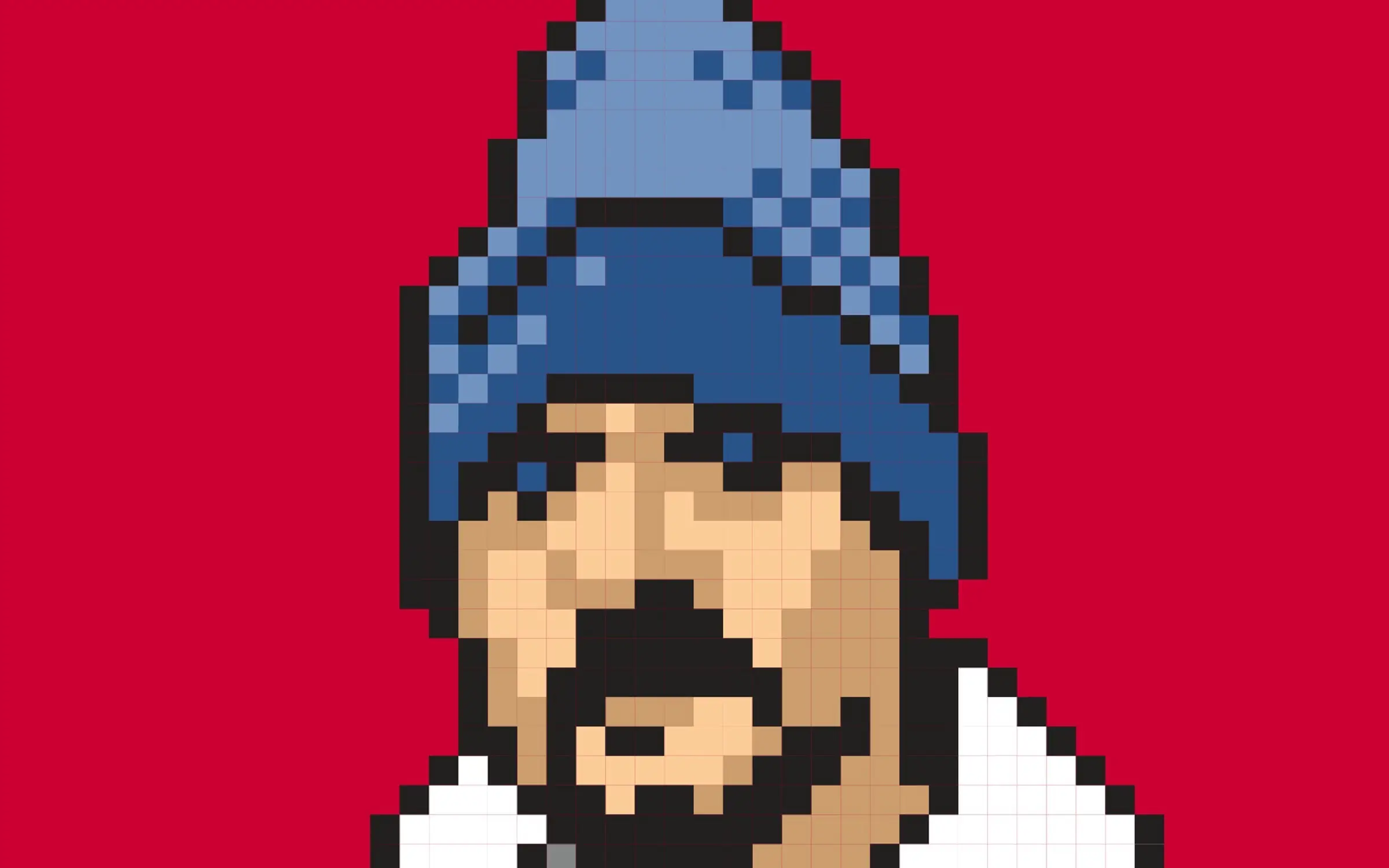
For love of pixels: Stroll with us down memory lane as we celebrate the pearl anniversary of pixel art creation’s primary progenitor, and some of the many artists and design languages it inspired.
I started using Twitter before the dawn of the iPhone. Back then, in 2006, it was a fun, funky, fully functional (if barebones) beta messaging service used mainly by The People of the Web™—the kind of folks who attended the SXSW Interactive conference and probably spoke on the panels.
You know. You were there. You were one of us: Designers. Developers. Pioneers. Writers of blog posts, trade books, and all the little guide texts that websites depended on to attract and serve their users. People who, in casual conversation, might use words like “digerati” unironically and without intending to be pretentious.
We believed in the power of the web to highlight unheard voices and evolve a more just society. If we were naive, and we surely were, at least we were on the side of the angels. Turns out, not everybody was.
A new skill
Years before Slack, the early 140-character Twitter served as a kind of private pre-Slack for the digitally awake and aware.
Back in those days, if you’d asked me or my conference-going fellow bloggers and designers who that first, rudimentary Twitter was for, we’d have said it was for us. For people like us, who’d spent years mastering all manner of skills and technologies simply to communicate online. Who saw value in the act of putting words together, so long as there were people to read and react to those words.
(After expressing our feelings of pride and ownership in the Twitter community, of course, the more Ted-talk-y among us early users would have waxed rhapsodic about microblogging and its potential to improve the world. More about that in a moment.)
With the birth of Twitter, when we wanted to pin down something that was twitching about in our heads and transmit it to other heads, the skill we needed wasn’t CSS or HTML or art direction or back-end wrangling. It was the ability to edit our thoughts down to a glittering trophy built with 140 characters or less. A new skill to master!
How much do people like us love showing the world what we’ve learned! This much: Even after Twitter no longer relied on wireless carriers’ text messaging services, so that the permitted character count was consequently doubled, many of us would-be Oscar Wildes continued to whittle away at our tweets, limiting them to 140 characters or fewer on principle.
Years later, with a huge international user base, the idea persisted that a globally connected free and open messaging network like Twitter could help humanity do less evil and more good.
If you wanted proof, you could look to the first Arab Spring, to Me Too, to Occupy Wall Street and Black Lives Matter—movements that were greatly abetted by the busy, worldwide network.
Of course, while many cheered and participated in these activist-driven movements, others saw them as threatening. Some felt the world was changing too fast, and that their views on social issues, like their once-good jobs, had no champion among the ruling classes. We all know how that turned out.
And now a brief digression about power and megaphones:
How I got over
Nearly two decades before Bluesky and its sweet starter packs, Twitter hired creatives to recommend selected users to newcomers. Some of the coolest people I know did that work.
Web design was at its peak, so quite naturally the in-house team put together a list of influential designers, developers, and writers for new users to follow. And for a variety of reasons, I was among those early recommended follows. (I may still be listed there, if the current X still welcomes newcomers with follow recommendations.) Which is how, at my Twitter peak, I ended up with a blue checkmark and 355,000 followers.
Even now, on wretched “X,” where I no longer post, I still retain 305,000 followers. At least, that’s what the stats told me when I popped in just now to find out. But are there really that many folks following me there?
How many of my current Twitter/X “followers” used to participate but have since quit quietly, without bothering to close their accounts? Lots, I reckon.
Some may avoid the site but keep their accounts open for strategic reasons, such as preventing someone else from hijacking their name (not that the owner can’t take over your account whenever he feels like it—but I digress).
Mainly, I’m guessing a lot of folks lost interest in the site but forgot to close their accounts. In other words, the data says 305K, but it’s probably less than half that many active users at most, few of whom would even see my tweets if I still posted there, as the algorithm throttles texts from folks like me.
Who cares, besides me? Nobody. Nor should they. And, besides, except as a temptation to stay, my follower count is beside the point.
Come play with us, Danny
The point is that the former Twitter has become a hateful cesspool, not simply mirroring but amplifying its owner’s profound insecurities, god-awful beliefs, and self-serving lies, and forcing that insanity into the public consciousness, whether we avoid X or not.
Thus, millions of Americans who don’t use Twitter/X nevertheless believe conspiracies that the owner and his favorite acolytes use the site to broadcast.
Just as nobody who marries spends their wedding day planning their divorce, almost nobody starts a business contemplating what rocks it will eventually splinter and break upon, and how to build a life raft for themselves.
I take that back. Some folks I know, who played pivotal roles in the evolution of the web, actually started their businesses with a clear goal of selling them to somebody bigger. Like Typekit was designed to sell to Adobe. Or Blogger was designed to sell to Google.
Such folks, several of whom are now post-economy wealthy, lived in the Bay Area in the 1990s and early 2000s, where building to flip was widely discussed and accepted.
Meanwhile, in NYC…
I, on the other hand, live in New York. So I started my web businesses (like Happy Cog™ design studio) to serve clients, as NYC creatives have always done, and with no understanding that I would one day need to leave the company and should have an exit plan. Why would I exit? Why would I ever stop doing work that brought excitement and meaning to my life?
Similarly, I started my personal site with its “Ask Dr. Web” tutorials in 1995, and co-founded my web design publication, A List Apart, in 1997, for the sheer joy of sharing knowledge, with no concept of making money, let alone of one day selling the business.
Eventually, despite my naivete, and mostly thanks to Jim Coudal and Jason Fried, A List Apart began making money by running one carefully screened ad per page. I used that money, as you will expect, to pay our writers, editors, and producers. And when it came time to stop running ads, I slowed our publication schedule, paid writers out of my own pocket, and worked with a small crew of fellow volunteers, who published ALA because we believed in the mission. (Still do.)
If I had come of business age in San Francisco, I likely would have sold A List Apart to somebody like O’Reilly, but that was never my plan because I make toys to play with, not to give away.
We published HTML5 For Web Designers the day after Steve Jobs, waving an iPhone on the world’s biggest stage (okay, sitting at his desk), announced that Flash was dead because HTML5 would bring app-like dynamism to the web using open standards instead of proprietary code. It (our first book, I mean) sold brilliantly. “Gee, publishing isn’t that hard” I naively told myself. (No, I knew it was hard. My favorite publishers had been laying off my favorite editors for ten years before my partners and I took the plunge. But the early success did make me think the books we published about web design would always find a large, eager audience. In time, I would learn otherwise.)
And while we began the publishing house by relying on the best writers we knew personally to write about the topics they were most passionate about, I’m proud to say that, as we went along, we also discovered brilliant first-time book authors, helping them create perfectly polished, fluff-free manuscripts that made genuine contributions to our readers’ understanding of UX and all it entails. (And not just to our readers. The insights they brought to their work after digesting our books rubbed off on their colleagues.)
In giving these brilliant writers a platform, we not only helped them take their careers to the next level, we also helped people who create web content think and work better, which in turn helped the people who used the websites, applications, and products our readers designed and built. Of that, I am proud.
Stay hungry
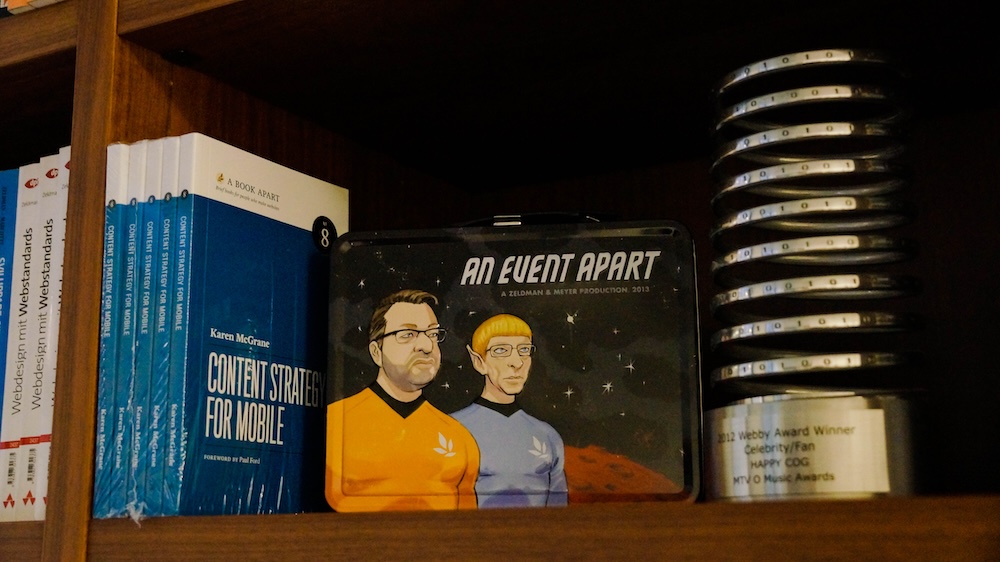
An Event Apart (RIP) was also a damned fine early success. Web designers liked our innovation of a multi-day, single-track conference, with a holistic approach to web design, code, and content, and unifying themes between the individual talks. Our freaking-amazing speakers debuted Huge Ideas including Mobile First and Responsive Web Design—ideas which, like perfect contextual menus in UX, arrived at the very moment designers needed them.
Not only that, but these humble geniuses also sat in the auditorium with our audience for all three days of each conference event: listening to each other’s presentations, and updating their own presentations to better bounce off each other’s ideas and the evolving themes of that particular show.
I could spend hours telling you how our producer Toby M. made miracles happen at every show, or how person-in-charge Marci E. brought joy to our community. How many of our speakers became authors. How some “graduated” from An Event Apart as newcomers replaced them. How the diversity of our speaking line-up, which wasn’t terrific in 2008, improved greatly each year. (Not that we ever said, “We need another black speaker” or “We need a trans speaker” or what-have-you. Just that we learned to swim outside the pool we came from, and discover great talent everywhere.) Our speakers were also almost uniformly Just Nice Good People, which doesn’t always happen when you’re collecting the greatest minds in an industry.
That’s not even to mention the incredible people who attended our shows, some of whom became lifetime friends for me.
So why, given the joy these businesses brought to everyone connected to them, including me, would my partners and I have even conceived of an exit strategy? We wanted the Good Times to roll on forever.
But of course they never do.
Things end
COVID did in An Event Apart. Some conferences survived, of course. Different priorities, different overheads, different business models. Some that survived do not pay their speakers. Others, where the conference is an adjunct to a bigger business, laid off or reassigned conference staff while the pandemic made live events impossible. Others that survived mostly rely on volunteer labor, whereas we had paid staff. They were worth their weight in platinum, and we’d have paid them more (because they were worth more) if the pandemic and six-figure hotel contracts hadn’t made continuing the show impossible. My partner and I earned nothing during the business’s last five years, and got personally stuck with a six-figure debt when the event closed. It is what it is.
Although books should be COVID-proof, multiple financial problems eventually beset our publishing house as well. For most of the run of the business, my partner and I earned nothing beyond the glow of contributing to our community’s knowledge. We paid our CEO, authors, and editors, kept nothing for ourselves, and tried, oh how we tried, to keep the business going as its revenues tanked.
Speaking only for myself, I’ve learned that I am good at starting businesses and keeping them going creatively, as long as somebody else figures out the money. I suck at that, and I’m obsessed with the notions of fairness and self-sacrifice that were drummed into me by a narcissistic family that valued me for taking on the roles they were emotionally incapable of handling—such as bringing up my baby brother in my father’s absence, which no child is equipped or should be asked to do, and yet it happens all the time. Growing up this way made me put my own self-interest last. Which is also why it never occurred to me to plan an exit. And by the time I needed to do so, the businesses were not in shape to sell.
Closing a conference is bad, but attendees can go to other conferences, and speakers can speak at other conferences; closing a conference doesn’t end a community. It sucks for the business but doesn’t strand participants.
But closing a publishing house hurts like hell, and you feel you let everybody down. I know how much our closing hurt some of our authors, and I think about that, instead of the good we achieved, when I look back.
No doubt when my partner and I write the large personal checks to cover our deceased business’s outstanding debts, we’ll be regretting the harm our closing caused, not basking in the warm glow of how many careers we changed for the better. Like the standup comedian who obsesses about the guy who’s frowning at table 3, and doesn’t hear the laughter of the rest of the crowd. We also, hopefully, won’t focus too closely on our financial wreckage. Just pay the bill, and move on.
Anyway, I hadn’t publicly addressed the endings of these businesses, so I figured it was time to do so. I’m sharing my experience only. If you ask any of the people I worked with on these projects, they might have a different story to tell. And that would be their story, and it would be every bit as valid as anything I’ve said here.
I also didn’t ask permission of my partners, speakers, or authors before sharing these thoughts. Probably I should have. But, hey. As I’ve said. I’m speaking here only for myself.
So, anyway.
Parting gift
Is it worth the risk of starting a web-related business that isn’t a venture-backed startup? I still think it is, and I applaud all who try. Heck, I might even do so myself someday. If you’re doubtful because of (((gestures at everything))), it might be worth noting that I started Happy Cog™ during the dot-com crash, when studios were closing all around me. And we launched A Book Apart during the world financial crisis of late 2008. Don’t let (((all this))) deter you from trying something bold. Let me know when you do. I’ll keep watching the skies.
P.S. Under swell third-party ownership and management, Happy Cog is still going strong. Check it out!
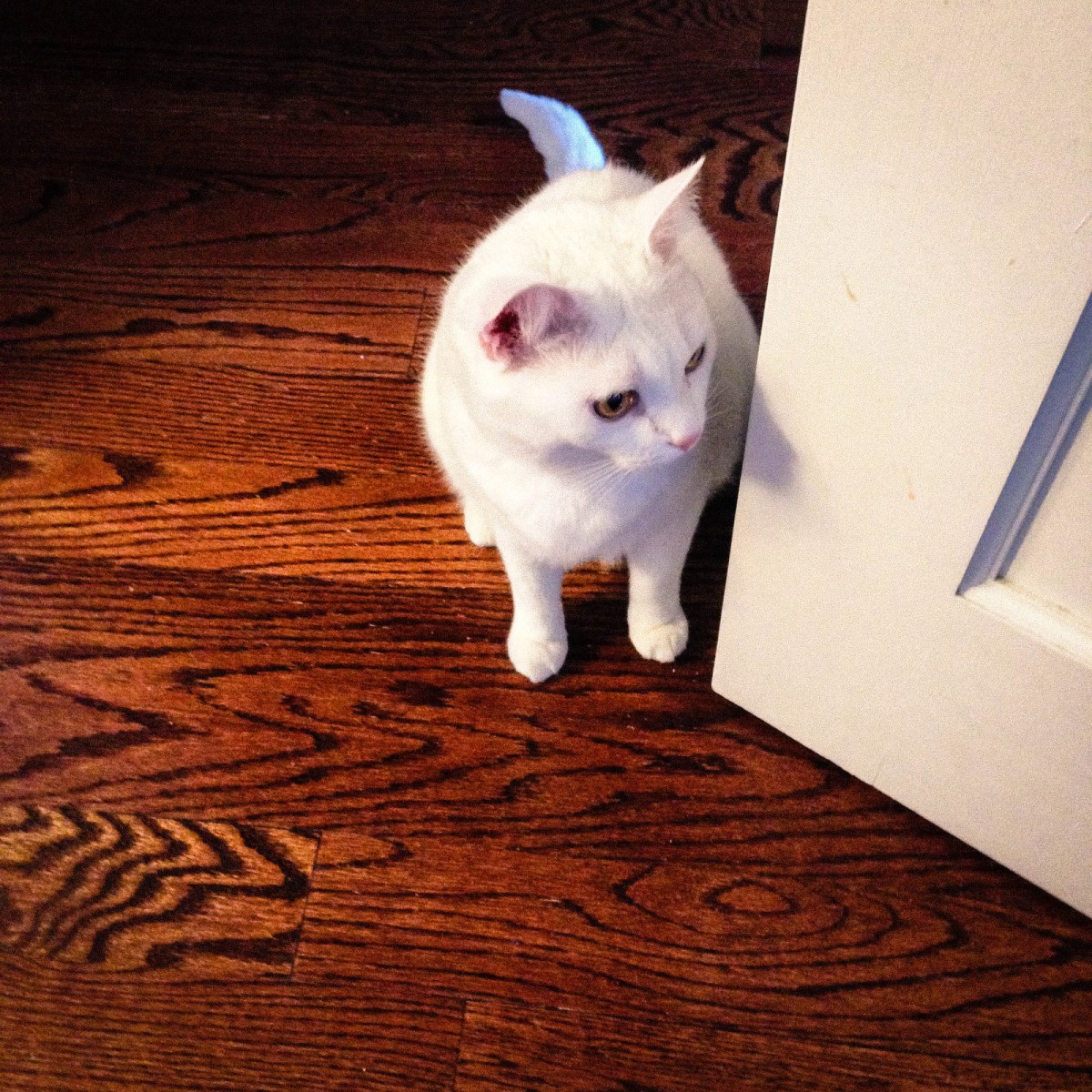
There’s Snow White, our 16-year-old queen and my daughter’s consigliere, who, despite requiring thrice-a-week medication injections to keep her kidneys functioning, rules this place absolutely.
There’s subtle Mango, whose first year of life involved struggling to survive—and avoid human contact—in a weedy vacant lot adjoining the United Nations Secretariat building, and who, since entering our family, spends nearly all day, every day hiding. He hides under my bed until it’s time to hide in a closet. Once hidden in a closet, he becomes magically invisible until he chooses to reveal himself, hours later, staring at us from the end of a hallway, meowing softly, or waking me for cuddles at 3:00 am. (Somehow if I am on my back, asleep, I am less frightening to him than when standing or moving, and this lessening of fear allows him to settle near me and assure me that, despite all his hiding, he loves me.)
Jasper the kitten
But today’s story is about the junior member of our feline menagerie, Jasper—discovered at age two months, challenging death by dashing back and forth across car-and-bus-and-bike-ridden East 34th Street in Manhattan, apparently quite lost. We adopted him pronto and eased him into his elders’ company. He’s now nearly a year old, is longer and bigger than his elders (with huge paws—mark that—indicating how much larger he will grow), is curious about everything and fears nothing, loves people and two particular dogs as much as he loves Snow White and Mango, and is keen-witted beyond his years … and beyond most people’s guess as to the limits of a cat’s intellect.
Want proof? Slightly after dawn this morning, Jasper did something very smart (but also quite disgusting). So set aside your coffee and crumpets while I tell the tale:
A morning surprise
All three cats share one giant litter box in my bathroom, giving the room less-than-spa-spotlessness. I never feel completely clean on stepping out of the shower, because, at the very least, my preternaturally alert yoga feet will provide detailed feedback on every speck of cat litter that somehow inhabits the floor, no matter how often I sweep and mop it. If I owned a house, I could stash the litter box somewhere else, but I live in a New York apartment, so my potty casa is their potty casa.
I cleaned the cat box yesterday. But somehow, despite the relative freshness of its sands this morning, Jasper got cat shit on the bottom of his paws.
There was also cat shit tracked all over my bathroom floor and the hall between my bathroom door and the door to my room.
I suspect that Snow White (who is, after all, saddled with sick kidneys, and who pees on “puppy training pads” about ten times a day) somehow knocked a buried turd out of the deep sand onto my floor. Either that, or a messy fragment of her morning meditation got stuck to her fur and thence tracked everywhere. Thus did a noticeable layer of shit end up coating young Jasper’s pads.
The clever bit
But the fun part is, seeking cleanliness, young Jasper jumped up on my sink counter, which is always slightly wet (because New York apartment plumbing is, well, legendary) and tracked shit prints all over my sink to get the shit off his paws.
The keen-witted kitten had calculated correctly that that a wet stone or formica surface would, if contacted repeatedly, eventually clean all the shit off of him. And it worked. It cleaned his paws, and left me plenty of janitorial tasks to perform.
Thus, before coffee or even a sip of water, my first duty on waking on this American holiday morning was to address a poo-streaked double sink and dreck-dappled tile floor.
Which I didn’t mind, because I enjoy tackling unexpected little handyman jobs, even deeply unglamorous ones, first thing in the morning. Gets the heart going. Keeps me from jumping compulsively into desk work by giving me something slightly more physical to do first.
And of course I was proud of little Jasper’s creativity in figuring out how to wash his hands, as it were. Good boy!
Anyway, I got it all clean this morning and took all the mess down to the recycling room. We don’t pay our porters enough.
The moral to my tale
I hope you enjoyed my story as much as I enjoyed sharing it. And please remember, the animals we’re privileged to live with are far smarter than we give them credit for. And, most mysterious of all, in spite of all that intellect, they love us.