As we finesse a few details of this site’s current redesign, it’s worth reviewing where we began, going back all the way to our launch in the spring of 1995.
Visual punk rock: 1995 ƒƒ
Frozen in still screen capture form below are two pages from my GIFPLEX (1995), which is still viewable on the current site. It used tables for layout and employed left and right ASCII arrows to guide the visitor through a series of animated GIFs. I made the GIFs by sampling homemade Beta and VHS tapes from my collection, using Gifbuilder, a System 7-friendly shareware video-to-gif tool. Psychotronic film fans and MST3K devotees may recognize a few frames from “Horror of Party Beach.”


And here (viewable via the Web Archive) is what the home page looked like at the end of that first year:

Note that earlier versions—and there were many; I changed the design every few days—are not available via the Wayback Machine, as it was not yet invented when I launched this site. All of those early pages, which were handspun in HTML, used to still be available live here at zeldman.com, but a few dozen or more were misplaced during one of this site’s many server migrations across three decades, and the original files are lost to Zip and floppy disks whose raw materials (I hope) have long since been recycled. If not, then somewhere in a reeking landfill, these earliest pages lie waiting for alien archivists to discover them sometime before the death of the sun. But I digress.
I called my homepage toc.html, which stands for “table of contents,” and was influenced by the weird but prescient designer David Siegel, who, along with Lynda Weinman, was one of only graphic designers taking the new medium seriously. (Fun fact about Lynda: She dated Matt Groenig before he invented The Simpsons, and appeared as a character in his early comic strip, Life in Hell, which was serialized in alternative journals like the Baltimore/Washington City Paper, for which I was a freelance writer back in those days. I later had the pleasure of meeting Lynda at a 1998 digital conference event where Jeff Veen, George Olsen and I introduced the community to our newly launched developer advocacy group, The Web Standards Project. But I digress.)
Although I blogged from the day I launched, I considered blogging merely one strand of entertainment I expected the site to provide, hence the need for a toc to cover such amusements as The Ad Graveyard, Pardon My Icons, Disturbing Patterns, and Ask Dr. Web.
Here’s another ugly home page variant from that time for your viewing pleasure.

Liquid design—precursor to RWD
Here are some really old views of pages that are still up on this website. Note their “liquid design,” which was something many of us tried in the mid-1990s, before the technology developed that would permit the more sophisticated approach of Responsive Web Design. (For more on Liquid Design and its Jello and Ice Design partners, see this site’s “A Dao of Responsive Liquid,” our “15 Minutes” interview with Glenn Davis, and Digital Web Magazine’s “Liquid Web Design: Build it right and it will work no matter what the container.”)


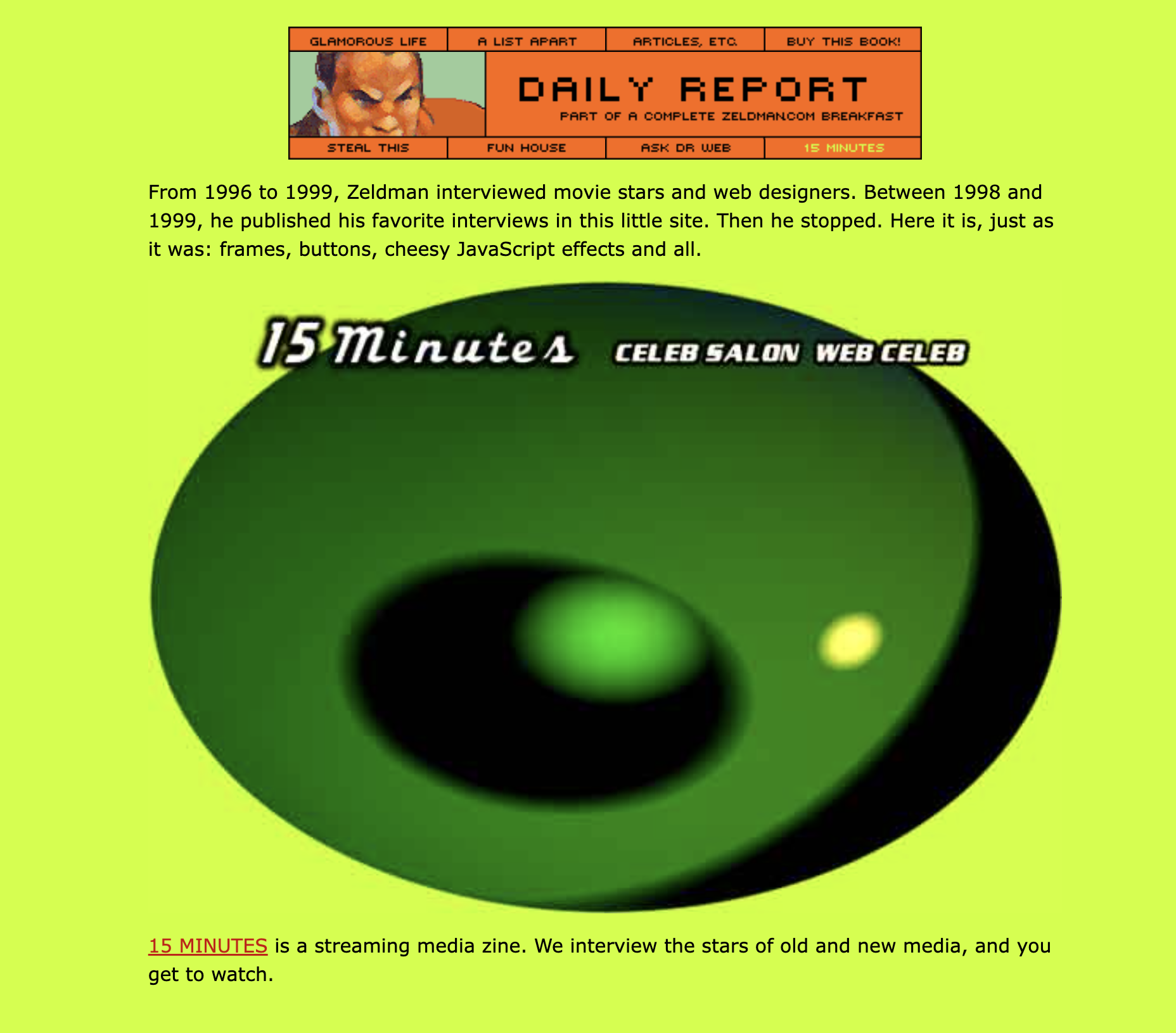
Fifteen Minutes
A zine within a website. You can still visit it here on this website. Fifteen Minutes featured my interviews with movie stars like Samuel L. Jackson and “web celebs” (early web creatives I admired, like Derek Powazek and the late Leslie Harpold). I performed the movie star interviews on behalf of Warner Bros., who were my client at the time, and published them on my website with permission from Donald Buckley, their VP Marketing, who also came up with the name, “Fifteen Minutes.” (Terrific guy, great mind; I was remarkably lucky in my clients.)


For your pleasure
Still available on the site, Waterbox was a collection of some of my music from the mid-1980s. These downloadable MP3 files were poorly mixed and never properly mastered, and MP3 is a lossy format—but they’re all I have left of the music I had composed, produced, and performed at my Red Flowers studio in Washington, DC during the latter part of the 1980s. Four decades later, I’ve begun composing and producing music again. You can stream my new LP-in-progress for free on Sonica (and eventually also on Apple Music and Spotify).

As an added bonus, go to the actual page and hover over the blue beanie in the orange box at the bottom of the page. It will animate to reveal my beanied punim. If clicked, it will take you to my current About page. (It used to take you to whatever toc.html page I had going that week.)
The “DHTML” TOC

One more ugly old TOC, from the beginning of the 4.0 browser era. The featured astronaut floated about on the page and the Emigre-set titles changed colors on hover. The animations were achieved via “DHTML,” which was briefly a name for JavaScript-plus-HTML. The combination of Emigre type, HTML Verdana, Photoshop outlines, and shareware microfonts is quite possibly the nastiest recipe ever to emerge from my demented early web kitchen.
The one you possibly remember

Here’s the version of Jeffrey Zeldman Presents the Daily Report that some of you will remember from the early 2000s. Note in the sidebar the inclusion of A List Apart (web design magazine launched 1998, still operational although we publish far less frequently these days), Happy Cog (my design studio, now under new and excellent ownership), and An Event Apart—the late, lamented web design conference I co-founded with Eric Meyer.

I iterated constantly on The Daily Report, which eventually became the most important part of this website (replacing toc.html as its homepage), and at some point will share more of this site’s visual history—the good, the bad, and the hideously ugly. I will also want to talk about the Big Type revolution this site and A List Apart underwent in the wake of antialiased web typography and the high-density monitors that became affordable for just about every computer user in the mid-2000s. Look for that in Part II of this À la recherche des sites perdu (apologies for my High School French), coming soon.
But what I want to write about next is what you’re soaking in: the current redesign of this website. This slog through the visual muck that got us here was a necessary preface to that exploration, which I promise to share with you quite soon indeed.


