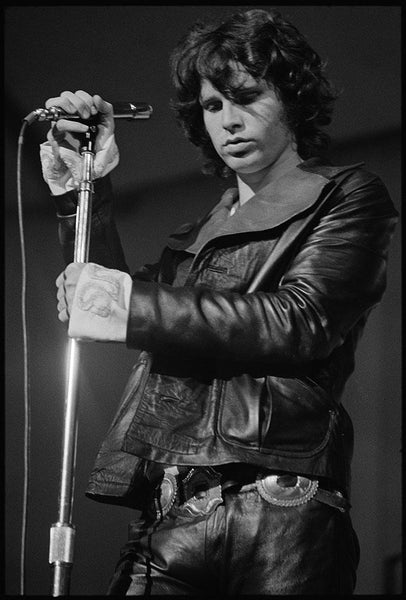
ON THIS DAY in 1971, Pamela Courson found Doors frontman Jim Morrison dead in the bathtub of their Paris apartment. The cause of death was heart failure. No autopsy was performed. Morrison was 27.
A year before, a teenaged me had watched the Doors play live at Pittsburgh Civic Arena. Tension at the concert was high, as Morrison was already in trouble with the law for having grabbed his own crotch during a performance in Miami a few months before. (A decade or two later, Michael Jackson’s self-crotch-grabbing would be considered a cool dance move, and enormous photos of Marky Mark grabbing his Calvin-Klein-clad crotch would cover city buses and billboards, unremarked by passing grandmothers and similarly square civilians. By then, male self-crotch-grabbing was a non-story. But back in 1970, in Nixon’s America, a long-haired boozer who sang “Back Door Man” was a threat to Southern Womanhood or whatever racist cops thought they were protecting us from when they weren’t busy beating and arresting Black men. But I digress.)
So there sat teenage me, excited to see a band I idolized—and whose keyboard parts I’d taught myself to play—but also sad and frightened, because Morrison was visibly drunk and unsteady, and my sheltered self had never before seen a real alcoholic stumble around on the street, let alone while spotlighted on a stage in front of thousands of witnesses. I was afraid for Jim Morrison. Afraid he would hurt himself. Afraid the cops would bust him again.
I was not alone in these fears, and the audience began catcalling the intense police presence at the show. So Morrison stopped the band and spoke to the audience, hoping to prevent a riot.
“Just remember, their motto is Protect and Serve,” Morrison said.
“Fuck ’em!” shouted a kid sitting in the row behind me.
The kid’s shout was so loud the band could hear it; so loud you can hear it on the Doors LP Absolutely Live, released later that year. The live shout is quiet on the record, which—after all—was recorded through a portable mixing board and not a live mic in the row behind me. Quiet enough that Elektra Records felt safe releasing the disc despite the puritanical speech restrictions of America in the 1970s. You have to listen closely to hear it. But it is there. Whoever the kid from Pittsburgh in the row behind me may have been, he is now an anonymous immortal footnote in rock history.
That story ends there and Jim Morrison’s ended soon after.
The next year I was taking Driver Training when the announcement of Morrison’s death came over the radio, which my high school driver training teacher always left on to keep himself entertained while teaching teenagers how to parallel park.
“Morrison died of a heart attack,” the news guy on the car radio said.
“Yeah, right,” my driver training teacher snickered—implying that the 27-year-old had almost certainly OD’d, like Jimi Hendrix and Brian Jones before him. He gazed at me meaningfully. Me with my long hair and weird ways. I didn’t play sports. I smelled of patchouli.
Coward that I was, I faked a small smile at my teacher’s remark, but inside, that day, I died a little.