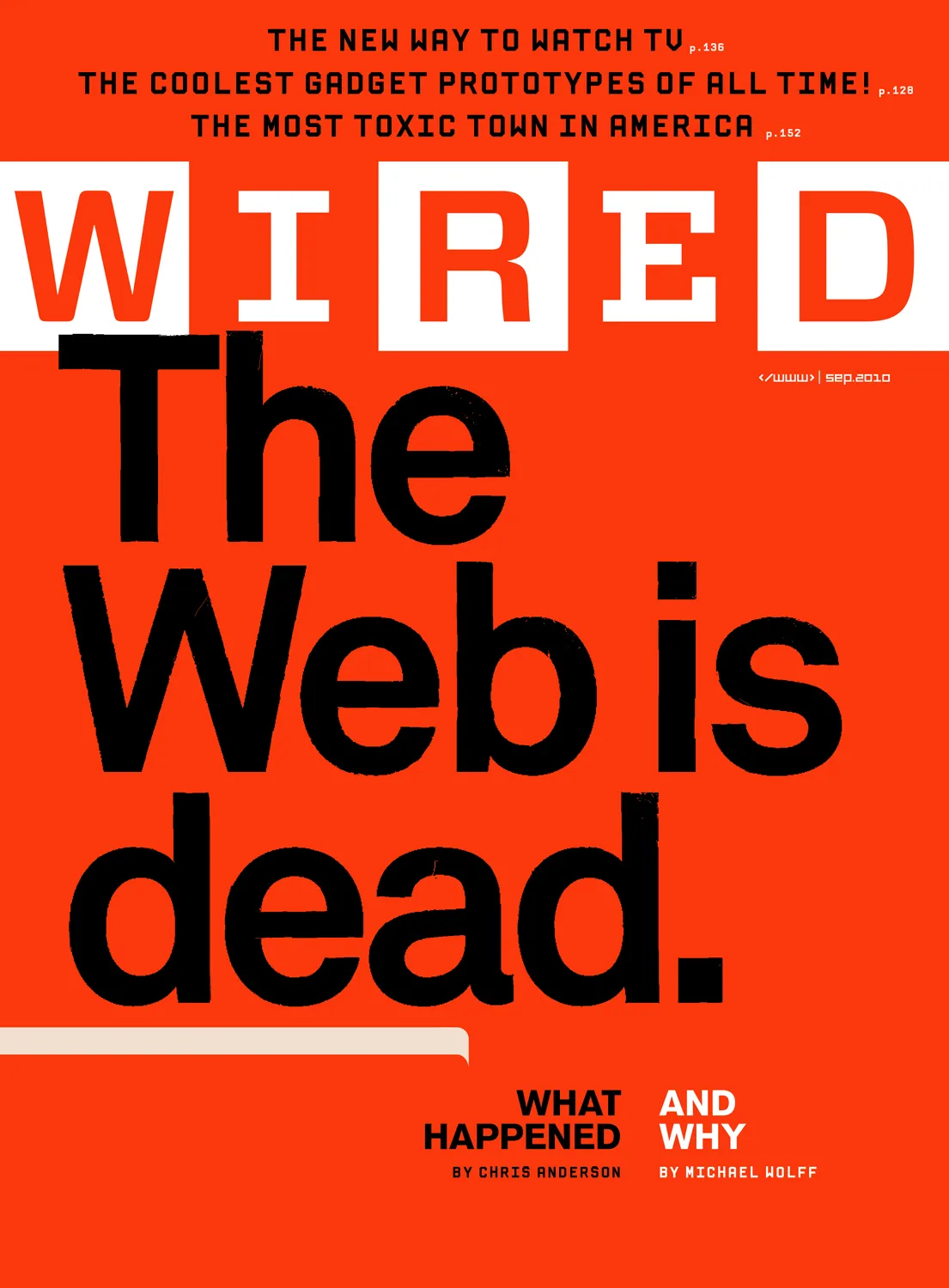
They say AI will replace the web as we know it, and this time they mean it. Here follows a short list of previous times they also meant it, starting way back in 1997.
Inspired by the success of PointCast, a clever application that displayed news headlines as a screensaver, our “Push!” story argued that Web browsers were about to become obsolete.
(I repeat, this was 1997. The Wayback machine was roughly one year old. Primitive CSS was newly available in IE3, but most folks at the time continued to use the Netscape browser, which they bought on disc at their neighborhood computing store.)
Though I dubbed it “the worst story Wired ever published,” I quickly began to get feedback from readers who argued that the predictions in the piece were coming true after all. The inspiring technology this time is RSS, a specification that allows easy syndication of news, blogs, and other frequently updated sources.
There is a clear parallel between the excitement of the PointCast days and the enthusiasm for RSS today, one that goes further than easy harvesting of news headlines. Search engine results, product information, new music, notification of recent blog comments, and many other types of digital information are becoming available through RSS. This dialect of XML brings us the Web as an evolving environment: customizable, variable in intensity, and always on. This is the old promise of push. We can see the potential for radically new types of media – again.
To be fair, whereas the 1997 story made mountains out of an early “push” app, this 2004 second attempt to declare the web dead caught a moment of genuine game change as RSS, Atom, and XML provided dependable web standards (not a lone application, as in the 1997 piece) for syndication.
But syndication, of course, did not kill the web; it brought forward much of its inherent value. All praise to Dave Winer and his confederates for RSS and Atom, and to WaSP member Tim Bray and his colleagues for XML: here’s a contemporary history of how that standard came to be.
You’d think Wired would be tired (see what I did there?) of hyping the end of the platform that gave the magazine its relevance, but no:
Two decades after its inception, the World Wide Web has been eclipsed by Skype, Netflix, peer-to-peer, and a quarter-million other apps.
(Observation: A Wolf wrote or co-wrote the first two articles, and a Woolf co-wrote the third. A meaningless coincidence, but if this were politics instead of tech, there would doubtless be a whole QAnon-style conspiracy theory about it. Especially since Woolf is often a Jewish surname. But I digress.)
The web profoundly changed the world, for better and worse, with the jury still out on some charges, but one thing hasn’t changed: every few years someone in an intellectual leadership position declares the web kaput. It survived previous bubbles (starting with the dot-com crash) and has proved hardy enough to continue providing profound benefits and hazards to the entire world, absorbing and deepening new technologies rather than succumbing to them.
Look, I understand why AI is bigger than Pointcast and how it is disrupting anything it can be stuck in, but the web is not going away. ’Cause think about it for five minutes, which is four and a half minutes longer than the authors of the previous hype cycles appear to have done. If AI kills the web that provides the information AI sucks down, then there is no contemporary body of news and text for AI to suck down and regurgitate. It would be like a parasite that kills the host body. There are occasionally such things in nature, but mostly, life finds a way, mostly. And so will the web. Now a word about those self-driving cars….
Many designers still think in px first when creating baseline styles. But we know intellectually that various relative typography approaches are better suited to our medium in all its complexity. Better for accessibility. Better for avoiding bizarre typographic disasters linked to user preference settings, device limitations, and the unforeseen ways our overwrought styles can interact with one another.
As I contemplate a long-overdue redesign of my own site, it’s worth taking a refreshing dip into what we’ve learned about web typography over the past 20+ years. From the pages of (where else?) A List Apart:
Bojan Mihelac: “Power to the People: Relative Font Sizes” (2004)
An early and simple creative solution for text resizing that respects users’ choices and also gives them an additional option for resizing despite the limitations of some of the most popular browsers of the day. Presented for its historical importance, and not as a how-to for today. https://alistapart.com/article/relafont/
Lawrence Carvalho & Christian Heilmann: “Text-Resize Detection” (2006)
Detect your visitors’ initial font size setting, and find out when they increase or decrease the font size. With this knowledge, you can create a set of stylesheets that adapt your pages to the users’ chosen font sizes, preventing overlapping elements and other usability and design disasters. Presented for its historical importance as an insight into the complex dancing we’ve done in the past to ensure readability. https://alistapart.com/article/fontresizing/
Richard Rutter: “How to Size Text in CSS“ (2007)
Sizing text and line-height in ems, with a percentage specified on the body (and an optional caveat for Safari 2), provides accurate, resizable text across all browsers in common use today. An early move toward more responsive type and away from the accessibility problems created by setting text sizes in px in some browsers and devices. https://alistapart.com/article/howtosizetextincss/
Wilson Miner: Setting Type on the Web to a Baseline Grid
The main principle of the baseline grid is that the bottom of every line of text (the baseline) falls on a vertical grid set in even increments all the way down the page. The magical end result is that all the text on your page lines up across all the columns, creating a harmonious vertical rhythm. https://alistapart.com/article/settingtypeontheweb/
“We must now practice a universal typography that strives to work for everyone. To start, we need to acknowledge that typography is multidimensional, relative to each reader, and unequivocally optional.” https://alistapart.com/article/flexible-typesetting/
Keep going…
For more web design community wisdom and web typography history, see Typography & Web Fonts in A List Apart, for people who make websites.
And in the Comments below, please share your favorite resources for creating websites that look great and read beautifully, no matter what technical and human capabilities get thrown at them.
Here’s a fact: “Opt-in” is great for programs a platform controls, but meaningless when that platform has no control.
Take, for example, oh, I don’t know, let’s say AI companies scraping web content without your permission. The heart wants to make content scraping permissions “opt-in,” so people who post content online are protected by default.
Except we won’t be. Smaller, “good” AI companies may comply with “opt-out” notices; big ones surely won’t. Scrapers gonna scrape.
So why even bother with an “opt-out” setting? Because companies that continue to scrape opted-out content may find themselves on the losing end of major lawsuits.
Of course there’s no telling how these lawsuits will work out—not with ketamine supervillains and their GOP enablers willfully violating consumer, worker, and climate protection laws here in the benighted States of America. But even so, an opt-out notice is a red line, and most corporate legal teams are cautious and sober—at least during working hours.
An opt-out notice is *something.* It smells funky, but has a chance of working.
Of course opt-in feels better. It’s how we’d do things if we had control over third-party scrapers. But we don’t have that control.
Which makes opt-in for AI scraping a feel-good but basically performative gesture. And we don’t have time for those.
However pretty it might be to think otherwise, something imperfect that might work beats something pure that won’t. Don’t hate me ’cause I’m beautiful. I’m only here to tell you what we both know in our souls.
I started using Twitter before the dawn of the iPhone. Back then, in 2006, it was a fun, funky, fully functional (if barebones) beta messaging service used mainly by The People of the Web™—the kind of folks who attended the SXSW Interactive conference and probably spoke on the panels.
You know. You were there. You were one of us: Designers. Developers. Pioneers. Writers of blog posts, trade books, and all the little guide texts that websites depended on to attract and serve their users. People who, in casual conversation, might use words like “digerati” unironically and without intending to be pretentious.
We believed in the power of the web to highlight unheard voices and evolve a more just society. If we were naive, and we surely were, at least we were on the side of the angels. Turns out, not everybody was.
A new skill
Years before Slack, the early 140-character Twitter served as a kind of private pre-Slack for the digitally awake and aware.
Back in those days, if you’d asked me or my conference-going fellow bloggers and designers who that first, rudimentary Twitter was for, we’d have said it was for us. For people like us, who’d spent years mastering all manner of skills and technologies simply to communicate online. Who saw value in the act of putting words together, so long as there were people to read and react to those words.
(After expressing our feelings of pride and ownership in the Twitter community, of course, the more Ted-talk-y among us early users would have waxed rhapsodic about microblogging and its potential to improve the world. More about that in a moment.)
With the birth of Twitter, when we wanted to pin down something that was twitching about in our heads and transmit it to other heads, the skill we needed wasn’t CSS or HTML or art direction or back-end wrangling. It was the ability to edit our thoughts down to a glittering trophy built with 140 characters or less. A new skill to master!
How much do people like us love showing the world what we’ve learned! This much: Even after Twitter no longer relied on wireless carriers’ text messaging services, so that the permitted character count was consequently doubled, many of us would-be Oscar Wildes continued to whittle away at our tweets, limiting them to 140 characters or fewer on principle.
Years later, with a huge international user base, the idea persisted that a globally connected free and open messaging network like Twitter could help humanity do less evil and more good.
If you wanted proof, you could look to the first Arab Spring, to Me Too, to Occupy Wall Street and Black Lives Matter—movements that were greatly abetted by the busy, worldwide network.
Of course, while many cheered and participated in these activist-driven movements, others saw them as threatening. Some felt the world was changing too fast, and that their views on social issues, like their once-good jobs, had no champion among the ruling classes. We all know how that turned out.
And now a brief digression about power and megaphones:
How I got over
Nearly two decades before Bluesky and its sweet starter packs, Twitter hired creatives to recommend selected users to newcomers. Some of the coolest people I know did that work.
Web design was at its peak, so quite naturally the in-house team put together a list of influential designers, developers, and writers for new users to follow. And for a variety of reasons, I was among those early recommended follows. (I may still be listed there, if the current X still welcomes newcomers with follow recommendations.) Which is how, at my Twitter peak, I ended up with a blue checkmark and 355,000 followers.
Even now, on wretched “X,” where I no longer post, I still retain 305,000 followers. At least, that’s what the stats told me when I popped in just now to find out. But are there really that many folks following me there?
How many of my current Twitter/X “followers” used to participate but have since quit quietly, without bothering to close their accounts? Lots, I reckon.
Some may avoid the site but keep their accounts open for strategic reasons, such as preventing someone else from hijacking their name (not that the owner can’t take over your account whenever he feels like it—but I digress).
Mainly, I’m guessing a lot of folks lost interest in the site but forgot to close their accounts. In other words, the data says 305K, but it’s probably less than half that many active users at most, few of whom would even see my tweets if I still posted there, as the algorithm throttles texts from folks like me.
Who cares, besides me? Nobody. Nor should they. And, besides, except as a temptation to stay, my follower count is beside the point.
Come play with us, Danny
The point is that the former Twitter has become a hateful cesspool, not simply mirroring but amplifying its owner’s profound insecurities, god-awful beliefs, and self-serving lies, and forcing that insanity into the public consciousness, whether we avoid X or not.
Thus, millions of Americans who don’t use Twitter/X nevertheless believe conspiracies that the owner and his favorite acolytes use the site to broadcast.
If you have a website that gets steady but diminishing traffic, and whose domain registration dates back at least a decade, you may encounter offers to buy your domain. These used to come mainly from pornographers, on the premise that your readers, upon encountering nudity instead of the morning farm report in their web browsers, would be momentarily confused—but at least a few of them would stick around to become customers.
Over the years, tricking people into seeing unexpected content and converting a small percentage of them into customers has proven to be an effective business tactic. Mindless, sure. Depressing, you bet. But effective. If all you want to do is make money, this is a way to do it. See also the penny rounding error crime from Office Space (by way of Superman III). It’s a numbers game. Make an infinitesimal profit a gazillion times, and it becomes a healthy profit. Buy skrillions of popular domains at a low enough cost, and rake in double your money in subscription fees and paid downloads.
These days, of course, the lowball domain harvesters are not limited to pornographers or even human beings, but the point of the transaction has ever been the same: to ambush your community and convert at least some of them into customers.
What I’m working up to is that, for some reason, this morning I woke up recognizing that Elon Musk’s purchase of Twitter was a far more expensive—and destructive—version of that same old grift. It was conversion en masse. To seize a public commons shared by 600 million readers, writers, and keyboard adrenalin addicts, and to profoundly change the conversations they were having. A digital takeover with historic and deeply tragic real-world consequences.
For sale: personal, imperial power
Musk’s “folly,” it turns out, wasn’t the ego-fueled, soon regretted impulse purchase it looked like. At least, if it was that, it was not only that. It was also, as we can see now, a plan to buy not merely a U.S. presidential election outcome, but, with it, personal, imperial power. Whether that was always the plan, or only became the plan after Musk found himself stuck with the $44B Twitter deal and decided to make the best of it, the consequences for our world are the same. And, from Musk’s point of view—at least until he and the man he helped put in the White House have their inevitable supervillain falling out—the plan worked.
A psychological detail here is that, in contrast to the lowballing sleaze merchants whose tactics he otherwise emulated, Musk appeared to have wildly overpaid for his prize. How could he be so stupid, we grinned at each other—and put him out of our minds. Which gave him that much more freedom to make his moves. Which, although evil, were not stupid.
As an unelected U.S. co-president in an administration in which two-fisted self-dealing will be expected, and will go unreported by a weak and cowering press, Musk will become his own Treasury Department in his role as a cutter of “government waste.” (End Medicare. Get a job, Grandma! Launch Medicare dollars into SpaceX. While we’re at it, let’s stop pampering our military veterans with health care. And so on, ad nauseum.) And if that’s not enough—and somehow it never is enough for these people—he’ll also rule over economic realms in which his companies compete for astronomical government contracts. Gee, I wonder how that will go?
Either Musk deliberately spent enough to make his enemies think he was an idiot, and stop paying attention to him. Which is evil-genius-level chess-mastery if it was, in fact, planned that way. Or else he overspent as a bluff, got tripped up in his own hubris, ended up stuck with Twitter, decided to wreck it while high on Ketamine, and somehow blundered his way into a revenge plan for the history books—if we’ll still be allowed to have those. Either way, the rest of us are in the same bad trouble.
All things considered, the Titanic sank quickly. Our democracy has just a tad more time. What can good people do today to give non-billionaires a fighting chance?
Just as nobody who marries spends their wedding day planning their divorce, almost nobody starts a business contemplating what rocks it will eventually splinter and break upon, and how to build a life raft for themselves.
I take that back. Some folks I know, who played pivotal roles in the evolution of the web, actually started their businesses with a clear goal of selling them to somebody bigger. Like Typekit was designed to sell to Adobe. Or Blogger was designed to sell to Google.
Such folks, several of whom are now post-economy wealthy, lived in the Bay Area in the 1990s and early 2000s, where building to flip was widely discussed and accepted.
Meanwhile, in NYC…
I, on the other hand, live in New York. So I started my web businesses (like Happy Cog™ design studio) to serve clients, as NYC creatives have always done, and with no understanding that I would one day need to leave the company and should have an exit plan. Why would I exit? Why would I ever stop doing work that brought excitement and meaning to my life?
Similarly, I started my personal site with its “Ask Dr. Web” tutorials in 1995, and co-founded my web design publication, A List Apart, in 1997, for the sheer joy of sharing knowledge, with no concept of making money, let alone of one day selling the business.
Eventually, despite my naivete, and mostly thanks to Jim Coudal and Jason Fried, A List Apart began making money by running one carefully screened ad per page. I used that money, as you will expect, to pay our writers, editors, and producers. And when it came time to stop running ads, I slowed our publication schedule, paid writers out of my own pocket, and worked with a small crew of fellow volunteers, who published ALA because we believed in the mission. (Still do.)
If I had come of business age in San Francisco, I likely would have sold A List Apart to somebody like O’Reilly, but that was never my plan because I make toys to play with, not to give away.
We published HTML5 For Web Designers the day after Steve Jobs, waving an iPhone on the world’s biggest stage (okay, sitting at his desk), announced that Flash was dead because HTML5 would bring app-like dynamism to the web using open standards instead of proprietary code. It (our first book, I mean) sold brilliantly. “Gee, publishing isn’t that hard” I naively told myself. (No, I knew it was hard. My favorite publishers had been laying off my favorite editors for ten years before my partners and I took the plunge. But the early success did make me think the books we published about web design would always find a large, eager audience. In time, I would learn otherwise.)
And while we began the publishing house by relying on the best writers we knew personally to write about the topics they were most passionate about, I’m proud to say that, as we went along, we also discovered brilliant first-time book authors, helping them create perfectly polished, fluff-free manuscripts that made genuine contributions to our readers’ understanding of UX and all it entails. (And not just to our readers. The insights they brought to their work after digesting our books rubbed off on their colleagues.)
In giving these brilliant writers a platform, we not only helped them take their careers to the next level, we also helped people who create web content think and work better, which in turn helped the people who used the websites, applications, and products our readers designed and built. Of that, I am proud.
Stay hungry
An Event Apart (RIP) was also a damned fine early success. Web designers liked our innovation of a multi-day, single-track conference, with a holistic approach to web design, code, and content, and unifying themes between the individual talks. Our freaking-amazing speakers debuted Huge Ideas including Mobile First and Responsive Web Design—ideas which, like perfect contextual menus in UX, arrived at the very moment designers needed them.
Not only that, but these humble geniuses also sat in the auditorium with our audience for all three days of each conference event: listening to each other’s presentations, and updating their own presentations to better bounce off each other’s ideas and the evolving themes of that particular show.
I could spend hours telling you how our producer Toby M. made miracles happen at every show, or how person-in-charge Marci E. brought joy to our community. How many of our speakers became authors. How some “graduated” from An Event Apart as newcomers replaced them. How the diversity of our speaking line-up, which wasn’t terrific in 2008, improved greatly each year. (Not that we ever said, “We need another black speaker” or “We need a trans speaker” or what-have-you. Just that we learned to swim outside the pool we came from, and discover great talent everywhere.) Our speakers were also almost uniformly Just Nice Good People, which doesn’t always happen when you’re collecting the greatest minds in an industry.
That’s not even to mention the incredible people who attended our shows, some of whom became lifetime friends for me.
So why, given the joy these businesses brought to everyone connected to them, including me, would my partners and I have even conceived of an exit strategy? We wanted the Good Times to roll on forever.
But of course they never do.
Things end
COVID did in An Event Apart. Some conferences survived, of course. Different priorities, different overheads, different business models. Some that survived do not pay their speakers. Others, where the conference is an adjunct to a bigger business, laid off or reassigned conference staff while the pandemic made live events impossible. Others that survived mostly rely on volunteer labor, whereas we had paid staff. They were worth their weight in platinum, and we’d have paid them more (because they were worth more) if the pandemic and six-figure hotel contracts hadn’t made continuing the show impossible. My partner and I earned nothing during the business’s last five years, and got personally stuck with a six-figure debt when the event closed. It is what it is.
Although books should be COVID-proof, multiple financial problems eventually beset our publishing house as well. For most of the run of the business, my partner and I earned nothing beyond the glow of contributing to our community’s knowledge. We paid our CEO, authors, and editors, kept nothing for ourselves, and tried, oh how we tried, to keep the business going as its revenues tanked.
Speaking only for myself, I’ve learned that I am good at starting businesses and keeping them going creatively, as long as somebody else figures out the money. I suck at that, and I’m obsessed with the notions of fairness and self-sacrifice that were drummed into me by a narcissistic family that valued me for taking on the roles they were emotionally incapable of handling—such as bringing up my baby brother in my father’s absence, which no child is equipped or should be asked to do, and yet it happens all the time. Growing up this way made me put my own self-interest last. Which is also why it never occurred to me to plan an exit. And by the time I needed to do so, the businesses were not in shape to sell.
Closing a conference is bad, but attendees can go to other conferences, and speakers can speak at other conferences; closing a conference doesn’t end a community. It sucks for the business but doesn’t strand participants.
But closing a publishing house hurts like hell, and you feel you let everybody down. I know how much our closing hurt some of our authors, and I think about that, instead of the good we achieved, when I look back.
No doubt when my partner and I write the large personal checks to cover our deceased business’s outstanding debts, we’ll be regretting the harm our closing caused, not basking in the warm glow of how many careers we changed for the better. Like the standup comedian who obsesses about the guy who’s frowning at table 3, and doesn’t hear the laughter of the rest of the crowd. We also, hopefully, won’t focus too closely on our financial wreckage. Just pay the bill, and move on.
Anyway, I hadn’t publicly addressed the endings of these businesses, so I figured it was time to do so. I’m sharing my experience only. If you ask any of the people I worked with on these projects, they might have a different story to tell. And that would be their story, and it would be every bit as valid as anything I’ve said here.
I also didn’t ask permission of my partners, speakers, or authors before sharing these thoughts. Probably I should have. But, hey. As I’ve said. I’m speaking here only for myself.
So, anyway.
Parting gift
Is it worth the risk of starting a web-related business that isn’t a venture-backed startup? I still think it is, and I applaud all who try. Heck, I might even do so myself someday. If you’re doubtful because of (((gestures at everything))), it might be worth noting that I started Happy Cog™ during the dot-com crash, when studios were closing all around me. And we launched A Book Apart during the world financial crisis of late 2008. Don’t let (((all this))) deter you from trying something bold. Let me know when you do. I’ll keep watching the skies.
P.S. Under swell third-party ownership and management, Happy Cog is still going strong. Check it out!
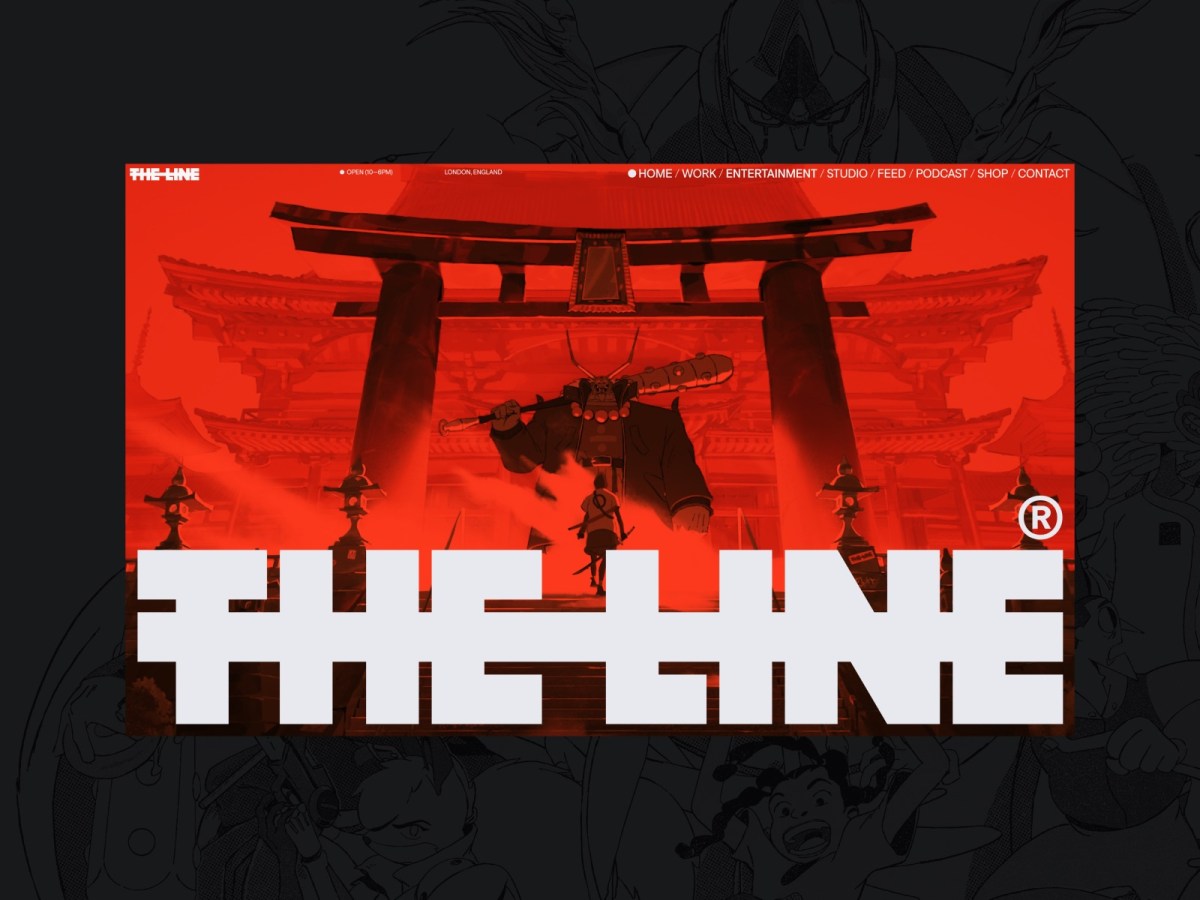
Red, black, and white. Always a good look. Screenshot of The Line website.
If you’re finding today a bit stressful for some reason, grab a respite by sinking into any of these web design inspiration websites.
Gathered from conversations on Reddit and elsewhere, each site offers a collection of other sites’ designs, chosen for impact, originality, and innovation. Each collection should offer at least a few designs that will inspire your own ideas and creativity—and most contain more than a few. Lots more.
We make no claims as to usability, accessibility, or appropriateness of design. Which doesn’t mean that the chosen websites are unusable, inaccessible, or inappropriate to the brand, subject matter, or needs of the audience. Indeed, from the care devoted to the graphical interface, we assume that many of these sites are as good under the hood as they are on the surface. But it’s just an assumption; we haven’t tested, and the point of this post is purely to share visual and creative inspiration. Enjoy!
Zoom has always included a clickable button/badge at the top left of its primary meeting interface window. Click the badge to copy the URL of that meeting. You can then, with just one more click in any messaging system, send that URL to the other meeting participants. Fast. Simple. Drop-dead easy. Elegant.
It comes in especially handy when people didn’t get (or didn’t see or for some reason can’t click on) the meeting link in their invite. Or when the meeting link is hidden behind a tab behind a tab behind a tab in their browser. Or for any of a dozen other reasons you might want to grab the URL of a meeting you’re in, and zap it to a colleague.
How wise are the designers of Zoom to have solved this problem!
And talk about usable! The button’s placement at the top left of the meeting window, with plenty of free open space around it, means that any user (regardless of software experience level) can quickly find the button when they needed it. It’s placed right where your eyes know to look for it.
Good design! Smartly focused on what’s most important to the user.
So, anyway, Zoom seems to have removed the button.
—As I discovered during a Zoom meeting with a colleague 30 minutes ago. (Or, more accurately, a Zoom meeting without that colleague.)
—Who texted me to request the Zoom URL. But I couldn’t send it to them. I couldn’t send it, because I couldn’t see it, because the interface was hiding it.
—Because Zoom has decided to remove that affordance, replacing it with… well, nothing, actually.
It is possible that the affordance still exists somewhere within the Zoom interface, in some gloomily cobwebbed, rarely visited subscreen or other. Possibly with a rewritten label, so that any Zoom customers lucky enough to find it will fail to recognize it, even if staring directly at it with the fixed gaze of an astronomer.
I don’t say Zoom has definitely removed one of the nicest (and possibly, in its humble way, most important) tools their product offered. I don’t say that because I can’t be sure. I merely say, if they haven’t removed this function, they might as well go ahead and do so, for all the good its hidden presence does for Zoom’s millions of users. If the tool is hidden somewhere in the deep background layers of Zoom, I sure couldn’t find it.
So, after wasting time hunting for and texting about the missing Zoom link affordance (here comes the punchline), my colleague and I ended up holding our Zoom call…
… in Google Meet.
If I were a Zoom executive or investor, this might worry me.
Offered with love, UX is hard, and not all decisions are in our hands.
ONE MONTH and 24 years ago, in “Where Have All the Designers Gone?” (my HTMHell design column for Adobe of March 20, 2000), I discussed the deepening rift between aesthetically focused web designers and those primarily concerned with creating good experiences online:
More and more web designers seem less and less interested in web design.
Over the past 18 months or so, many of the best practitioners in the industry seem to have given up on the notion that a low-bandwidth, less than cutting-edge site is worth making. Much of the stuff they’ve been making instead has been beautiful and inspiring. But if top designers wash their hands of the rest of the Web, whose hands will build it, and whose minds will guide it? The possibilities are frightening.
An Imperfect Medium for Perfectionists
Why were many of the leading graphic designers and studios at the time uninterested in web design? For one thing, designers trained to strive for visual perfection found the web’s unpredictability depressing. The article provided clues to the frustrations of the time:
Good designers spend hours tweaking typography in Illustrator and Photoshop. Then visitors with slow connections turn off images.
Of course, where professionals trained in graphic design saw a distressing lack of control, others glimpsed in the infant technology a tremendous potential to help people, pixel-perfection be damned. To reduce the conflict to a cartoon, you might characterize it as David Carson versus Jakob Nielsen—though doing so would trivialize the concerns of both men. Designers already charged with creating websites found themselves somewhere in the middle—barking themselves hoarse reminding clients and managers that pixel-perfect rendering was not a thing on the web, while arguing with developers who told designers the exact same thing.
Visually inspiring websites like K10k showed that the web could, if approached carefully and joyfully, provide aesthetic delight. But many designers (along with organizations like AIGA) were unaware of those sites at the time.
Us and Them
Another source of tension in the medium in 2000 sprang from the discrepancy between the privileged access designers enjoyed—fast connections, up-to-date browsers and operating systems, high-res monitors (at least for the time) offering thousands of colors—versus the slow modems, aging and underpowered computers, outdated browsers, and limited-color monitors through which most people at the time experienced the web.
Which was the real design? The widescreen, multicolor, grid-based experience? Or the 216-color job with pixelated Windows type, a shallow “fold,” and pictures of headline text that took forever to be seen?
To view your masterpiece the way most users experienced it, and at the syrup-slow speed with which they experienced it, was to have an awakening or a nightmare—depending on your empathy quotient. Some designers began to take usability, accessibility, and performance seriously as part of their jobs; others fled for the predictability of more settled media (such as print).
A New (Old) Hope
My March, 2000 article ended on an upbeat note—and a gentle call to action:
For content sites to attain the credibility and usefulness of print magazines; for entertainment sites to truly entertain; for commerce sites and Web-based applications to function aesthetically as well as technically, the gifts of talented people are needed. We hope to see you among them.
That was my hope in 2000, and, all these years later, it remains my vision for this web of ours. For though the browsers, connections, and hardware have changed substantially over the past 24 years, and though the medium and its practitioners have, to a significant extent, grown the Hell up, beneath the surface, in 2024, many of these same attitudes and conflicts persist. We can do better.
Minus the framesets that formerly contained it, you may read the original text (complete with archaic instructions about 4.0 browsers and JavaScript that broke my heart, but which Adobe’s editors and producers insisted on posting) courtesy of the Wayback Machine.
The wizards behind AI have been busy lately providing meaningful employment for digital nonpersons.
One of the hottest jobs for non-humans is crafting and deploying website guestbook spam. This market’s on fire!
If you thought the guestbook spam of yore was impressive, you ain’t seen nothing yet. The new, AI-assisted comment spam has improved keyword stuffing, fewer grammatical mistakes, and, best of all, there’s tons more of it. Your Comment section was never so useless!
And we’re not just talking quantity, here; we’re talking quality.
Compared to the spammers of yore, the new signal depressors have a bold confidence that proclaims, “Hello, world! I’m here to waste your time and extinguish what’s left of your hard-won reader community. Watch me work!”
Yes, the bots who shit in your sandbox are bigger, brassier, and better than ever at wasting your readers’ time and abusing your content to score points on the Google big board.
What’s that you say? You’re not a comment spam enthusiast?
In that case, do as I do: use Akismet to keep cruft where it belongs: off your website. Akismet was strong enough for the comment, form, and text spam of the past, and it’s strong enough for the new junk, too.
(Full disclosure: I work at Automattic, makers of Akismet, but I penned this post this morning purely as an Akismet customer, after happily reviewing the blocked comment spam on this here WordPress site of mine. Thanks, Akismet!)
So, I’m a web designer. And I also specialise in accessibility, design systems, and design.
…Why do I think that this is the best title? Here’s why.
I’m designing for the web. The infinitely flexible web. The web that doesn’t have one screen size, one browser, one operating system, or one device. The web that can be used by anyone, anywhere, on any internet connection, on any device, on any operating system, on any browser, with any screen size. I’m designing with the web. Using the web platform (HTML, CSS, JS, ARIA, etc.), not a bloated harmful abstraction. I have a deep understanding of HTML and its semantics. I love CSS, I know how and when to utilise its many features, and I keep up-to-date as more are added. I have a strong understanding of modern JavaScript and most importantly I know when not to use it.
The Wax and the Wane of the Web (2024): Forget death and taxes. The only certainty on the web is change. Ste Grainer takes a brief look at the history of the web and how it has been constantly reinvented. Then he explores where we are now, and how we can shape the future of the web for the better. – A List Apart
The Cult of the Complex (2018): If we wish to get back to the business of quietly improving people’s lives, one thoughtful interaction at a time, we must rid ourselves of the cult of the complex. Admitting the problem is the first step in solving it. – A List Apart
Dear AIGA, where are the web designers? (2007): For all the brand directors, creative directors, Jungian analysts, and print designers, one rather significant specimen of the profession is missing. – zeldman.com
Standardization and the Open Web (2015): How do web standards become, well, standard? Although they’re often formalized through official standards-making organizations, they can also emerge through popular practice among the developer community. If both sides don’t work together, we risk delaying implementation, stifling creativity, and losing ground to politics and paralysis. Jory Burson sheds light on the historical underpinnings of web standardization processes—and what that means for the future of the open web. – A List Apart
Corporations that take investors make an impossible promise to increase profits forever. Accordingly, they hire MBAs whose role is to juggle numbers to create ongoing, short-term profit. This juggling is frequently labeled “leadership.”
The juggling methods—abusing data, diminishing the primacy of the customer relationship, repeating what worked last year as if the demand for it will never end, and perpetually cutting costs—invariably remove value from the company. This, of course, results in more staff and cost cutting.
People who understand the customer and the product are ignored in favor of the number jugglers; research is disparaged in favor of a dogmatic relationship to data.
The people who wreck the company get the big paychecks. Eventually a bigger company buys the first company, further destroying its value. The wreckers exit with more money, 1980s-corporate-raider-style. Skilled workers are laid off, quality plummets, and the cycle begins again.
It is not a picture of every company, to be sure. But it applies to many, and accounts for much of the worker unhappiness plus customer frustration that characterize this time and contribute to our political unrest.
I wrote this post so you’d know to check that one. Do it.
What’s widely used, no longer particularly effective, and makes web content inaccessible to many people with disabilities? It’s our old friend CAPTCHA! In a group note dated 16 December 2021, the W3C explains how CAPTCHA excludes disabled users, and suggests alternatives which may be kinder and more reliable:
Various approaches have been employed over many years to distinguish human users of web sites from robots. The traditional CAPTCHA approach asking users to identify obscured text in an image remains common, but other approaches have emerged. All interactive approaches require users to perform a task believed to be relatively easy for humans but difficult for robots. Unfortunately the very nature of the interactive task inherently excludes many people with disabilities, resulting in a denial of service to these users. Research findings also indicate that many popular CAPTCHA techniques are no longer particularly effective or secure, further complicating the challenge of providing services secured from robotic intrusion yet accessible to people with disabilities. This document examines a number of approaches that allow systems to test for human users and the extent to which these approaches adequately accommodate people with disabilities, including recent non-interactive and tokenized approaches. We have grouped these approaches by two category classifications: Stand-Alone Approaches that can be deployed on a web host without engaging the services of unrelated third parties and Multi-Party Approaches that engage the services of an unrelated third party.
5 years ago, when the web turned 30, I called out some of the dysfunction caused by the web being dominated by the self-interest of several corporations that have eroded the web’s values and led to breakdown and harm. Now, 5 years on as we arrive at the Web’s 35th Birthday, the rapid advancement of AI has exacerbated these concerns, proving that issues on the web are not isolated but rather deeply intertwined with emerging technologies.
There are two clear, connected issues to address. The first is the extent of power concentration, which contradicts the decentralised spirit I originally envisioned. This has segmented the web, with a fight to keep users hooked on one platform to optimise profit through the passive observation of content. This exploitative business model is particularly grave in this year of elections that could unravel political turmoil. Compounding this issue is the second, the personal data market that has exploited people’s time and data with the creation of deep profiles that allow for targeted advertising and ultimately control over the information people are fed.
How has this happened? Leadership, hindered by a lack of diversity, has steered away from a tool for public good and one that is instead subject to capitalist forces resulting in monopolisation. Governance, which should correct for this, has failed to do so, with regulatory measures being outstripped by the rapid development of innovation, leading to a widening gap between technological advancements and effective oversight.
The future hinges on our ability to both reform the current system and create a new one that genuinely serves the best interests of humanity.
Bluesky was created to put users and communities in control of their social spaces online. The first generation of social media platforms connected the world, but ended up consolidating power in the hands of a few corporations and their leaders. Our online experience doesn’t have to depend on billionaires unilaterally making decisions over what we see. On an open social network like Bluesky, you can shape your experience for yourself.
Today, we’re excited to announce that we’re open-sourcing Ozone, our collaborative moderation tool.